A LOOK AHEAD

We don’t do any of those year-end lists.  From our perspective, us telling our customers what already happened doesn’t seem like very valuable information.  But, since we study vintages and have tentative game plans on virtually every relevant wine region, we believe giving consumers an opportunity to get a feel for what is ahead is a valuable service. 

There are plenty of things to look forward to over the next few months as certain vintages come to market.  There are still a good number of releases from the 2019 vintage in the southern Rhone coming.  As we saw with the early arrivals of the Cotes du Rhones and some Chateauneufs, Gigondas, et. al., 2019 is a pretty fabulous and seductive vintage. 

Are we saying it’s another ‘vintage of the century’?  We try not to overdramatize but saying something like that wouldn’t be a stretch.  The 2019s are generally plush, fruit-driven, and uncommonly hedonistic, and rate among the top vintages since 2000, no small thing considering the great run of harvests they have had in that part of the world.

As an added bonus, though we realize appealing to a much smaller audience, the 2019s from the northern Rhone are rumored to be on a par with epic harvests like 2009, 2010, and 2015, which is serious business.  Again fruit is the watchword, and the 2019s have it in spades.  As it usually plays out, hard-core collectors will be chasing a handful of big-name, limited production stars that will command hefty prices.  But for the rest of us, there will be some sensational efforts from less famous (and much less expensive) names and we will be looking for hidden gems from places like St. Joseph and Crozes Hermitage that will benefit from the fortunate weather.

Snap up all of the 2019 Burgundies that you can.  This is an exceptionally delicious vintage, one of the most flattering we have ever tasted out of the gate.  We have reasonable supplies now and expect a few more things over the early part of 2022. But, beyond that, the watershed will start drying up. There are good words about the 2020s. But there is a caveat in that severe frost in 2021 destroyed a lot of the crop and will likely create upward pressure on prices.

It’s an exceptional time for Bordeaux as well.  The 2018s are mostly here and exceptional.  The 2019s will be arriving over the coming months and they are spectacular as well.   After that, the 2020s are no slouch either as we found when we tasted barrels samples earlier this year. So if you are new to the game, you can put together a pretty impressive matrix from those three vintages and have a solid core of a cellar.

As for domestic wines, this will be a rather challenging year.  If you recall, there were widespread wildfires up and down the state and in parts of Oregon.  The timing was terrible for the later ripening reds and there were large quantities of premium grapes affected by smoke taint.  In many cases, conscientious vintners made little or no wine at all from certain varietals, Cabernet perhaps the most notable.

So what does that mean for consumers? Simply less wine available and higher prices on what is.  Vintners, after losing a big chunk of an entire vintage to the effects of the wildfires, will all have creative ways to deal with it.  Many will release less into the market so they can sell it themselves, or try to stretch two vintages over three years.  Some of the staples will sell out quickly and be off the market for a while.

What that scenrio does do is make everything we do find more important.  You may have noticed that we have been advising folks to buy a little extra on some of the Cabernet offers we have sent out over the past year, specifically with an eye on this approaching situation.  Well, it is pretty much upon us over the next 18 months or so. 

Fortunately, 2018 and 2019 are very attractive vintages in California and will fill the bill nicely as long as they are around.  Stock up. As for 2021, all we have heard is that crop size was down some, the harvest was early, and, thankfully, there weren’t widespread wildfires though perhaps there will be some effects from the drought in some places.

Those are the significant ‘bullet points’ for this year.  Other areas will provide some excitement, and we will continue to ‘dig’ as we always do. Spain and Italy will no doubt make contributions, and there seems to be new things to find in South America and new places to explore (Greece, Georgia). But we don’t have any other ‘sweeping’ statements about any other regions in terms of historic harvests.  It will be more about discovering individual successes.

As to the bigger picture, global warming will continue to improve ‘marginal’ areas by giving them a bit more ripeness to work with.  Global warming has also changed some weather patterns and brought about freak hail and frost events that make viticulture much more difficult from a financial perspective in some regions.  Simply put, those kinds of occurrences can make it difficult for growers to make a living (see Loire, Chablis among others). 

Finally, there will still be pandemic-related issues that will continue to put unpredictable spins on all kinds of things from shipping to harvests to lord knows what.  It doesn’t appear any of those things are going to change any time soon.  Though we’d advise the ‘bird in the hand’ mentality for the next few months, there’s still plenty of great wine in the world. Happy New Year!

HOUSE GRUNER?

There are multiple reasons why one might think a ‘house Gruner’ is a far-fetched idea. First, for most Americans, Gruner is definitely a ‘foreign’ grape, giving way to more familiar varietals as Chardonnay and Sauvignon Blanc as the choices for a “go-to” whites to have at the ready for visitors or dinner guests.

There are also cost issues. The ‘best’ Gruners can move into to high-$20 price points quite easily and there are a number of producers (Knoll, Prager to name a couple) that work at even higher price levels. Also, even with global warming, Austrians whites can vary quite a bit from vintage to vintage. While we aren’t suggesting that Gruner Veltliner is going to go ‘mainstream’ any time soon, if there were more vintages like 2019 and more folks like Richard Walzer, there’s no reason it couldn’t happen.

We’ve spoken highly of the 2019 vintage in Austria before, but had much fewer opportunities to work with the vintage than we would have liked. Like the heralded 2019s from Germany, the bulk of them were released during the height of the pandemic and were largely ‘absorbed’ by the market by the time things started to normalize (as that is defined these days).

As a quick reminder, the 2019s were pure, ripe, tender, expressive, engaging, and beautifully balanced. There was a supple mid-palate, bright, supporting acidity, beautifully woven white and yellow stone fruits, and subtle but present minerality. Balance was the key. Everything was proportioned like nothing we recall, with no sharp edges. That describes Richard Walzer’s Gruner Veltliner Reid Wolfsgraben 2019 to a tee. A nose of white peach and dried apricot, the palate was seamless display of peach, quince, wild herb, stones and salinity at the end. This is a very easy Gruner to like.

Richard Walzer’s tiny, virtually ‘one-man-show’ operation in the Kremstal is still pretty much under the radar. This is their ‘entry-level, volume’ bottling from a single vineyard of which only 1100 cases are produced and those are allocated. In other words, this source does not have a lot of distribution, nor any attention from the press.

Walzer farms sustainably and ferments traditionally via ‘whole cluster’ in stainless steel, where the wine then sits on the lees for five months. This vineyard sits at 900-1000 foot elevation and has an average of 45-year-old vines sitting in predominantly classic loess soils.

We can’t compare this 2019 to efforts from previous years because we’ve not seen this producer before. But we can tell you they nailed this one! There’s the added bonus of a $13.98 price point, a strikingly low tab for a Gruner of this quality, or pretty much any Gruner. If there was more of it consistently, it could start a Gruner ‘revolution’. As it is, it will have to be our little secret on one of the best Gruner buys around.

JUNIOR CHATEAUNEUF LOOK-ALIKE FROM SPAIN

In the early days of the Spanish invasion in the 90s, this was a staple and an important part of our lineup. It was also one of the first of its kind. Robert Parker himself said of the 1997 version in his review, “Readers can be sure I will be purchasing several cases for enjoying over the next several years. It tastes like an excellent Chateauneuf du Pape, and even though they can be terrific values, a Chateauneuf du Pape of this quality would sell for $20-$30 a bottle.”

Since that time there have been quite a few value selections from old-vine Grenache plantings in Spain that have created their own followings in this marketplace like Borsao, their ‘upper cuvee’ Tres Picos, and Las Rocas de San Alejandro  Garnacha Viñas Viejas. New ones are coming along all the time to the point where we haven’t talked about one of the originals, Nekeas El Chaparral de Vega Sindoa Grenache Old Vines 2018, in quite a while, though we have carried many vintages along the way.

This version allows us to talk about it once again. In truth, if you don’t, people forget about it. So do we for that matter, as it is very easy to get caught up with the new and different and not spend a lot of effort on solid brands that have performed admirably for years. Wines like this have value in any market and there are likely a lot of new buyers that have come along since the days we were talking about this wine a lot looking for a good value on a versatile red.

Bodegas Nekeas is located in the high country of Navarra, northeast of Rioja, and the vines that supply the grapes for this wine were planted between 1890 and 1960. That’s old, and incumbent with using grapes from such elderly vines is the naturally low yields and concentration that comes from that growing scenario as well as the depth of flavor that can’t be created by any other means than deep-rooted, old vines.

These are hillside vineyards composed of sandstone and calcerous marl with a long vegetative cycle, warm summers and a great shift between daytime and nighttime temperatures that preserve the wine’s bright acidity. They practically make themselves in that very little needs to be done when the grapes are harvested. It’s a unique situation that exists in this part of the world that allows wines like this to be sold for under $15.

The ‘stats’ are particularly impressive for this edition of El Chaparral which made it a perfect time to mention it again. The lead piece is from Josh Raynolds of Vinous who wrote, “Deep garnet. Mineral-tinged cherry, raspberry, vanilla and exotic spice aromas show excellent clarity and take on a smoky nuance with air. Appealingly sweet and expansive on the palate, offering juicy red fruit, rose pastille and spicecake flavors energized by a minerally topnote. Shows impressive energy and florality on the persistent finish, which is given shape by polished, even tannins…92 points.”

Throw in support reviews from Jeb Dunnuck (90 points) and James Suckling (92 points) and a $13.98 price point and you have a very viable value choice for those everyday occasions where you want something tasty, interesting, and not too expensive that will go with all manner of foods. That, for a lot of people, is most days.

SIERRA CANTABRIA GRAN RESERVA OTRA VEZ

 Yeah, we ran this as an email a while back. Sold a bit of it, too. But, being honest, we were a little disappointed in the response. We aren’t usually ones to repeat ourselves but, in this case, we wonder if we didn’t quite convey our enthusiasm well enough. Or was it the day we chose to run it, on a low-key Sunday as opposed to one of our typical weekday slots? Was the one number we posted, all there was at the time, not big enough? Not sure what it was but clearly the message didn’t resonate the way we expected.

This is a special wine, from an exceptional vintage, made by a trusted house, that delivered high quality with over a decade of bottle age for less than you’d pay for a middling, new release Napa Cabernet. It’s fabulous with steak but far more versatile than most other red wine choices with a wide range of foods. We literally drink this about once a week at my house and just wanted to make doubly sure everyone saw the message. That’s all we can do so here’s the piece again.

“We have been fans of Sierra Cantabria at many levels for a couple of decades.  We almost feel a familial connection with a couple of Rioja producers (Sierra Cantabria, Muga, La Rioja Alta, and Lopez de Heredia) as we have met the owners, visited the wineries, and sold their wines consistently for a long time.  Even though there are no ‘automatics’ here, and we seriously look hard at every new vintage from these vaunted producers, it is almost inconceivable that we wouldn’t have something on the floor from each of them. They are staples for the genre.

“Within that context, you have your high points, and today’s offer is one of those.  We were huge fans of the delicious Sierra Cantabria Rioja Gran Reserva 2009, one of the uncanny successes from this warm, successful-but-not-‘epic’ vintage. This time we are talking about the 2010 edition, from a vintage that has been acclaimed as one of the ‘best  ever’ from a fairly broad historical perspective. We have been waiting for months for this to arrive, the process bogged down not only by the usual pandemic-tariff-shipping scenario that has had an impact on everything, but an additional delay thanks to the importer changing horses and the ‘new guy’ getting their system in order.

“As to the vintage, we’ll put it simply…on the Wine Advocate vintage chart 2010 was the highest rated vintage along with 2016 and 2004, and a point higher than 2001.  In other words, pretty rare company as vintages go.    The story here is that the Sierra Cantabria Rioja Gran Reserva 2010 is a traditional blend of 98% Tempranillo and 2% Graciano from vines planted between 1950 and 1970.  Those vineyards employ ‘practicing organic,’ dry-farmed viticulture with certain selective biodynamic practices.  

“The grapes undergo rigorous double-manual sorting, both before and after destemming then temperature-controlled fermentation in stainless steel followed by malolactic fermentation in barrel.  The wine then spends 26 months in American oak barrels as is tradition for ‘gran reservas’, 25% new.   

“So how does this differ from the 2009?  More nuance, more elegance, more complexity.  The nose starts with the same kind of billowing dark fruits, but there is more focus and definition, and an even greater sense of purity.  Black fruits, damp earth, savory spice and notes of cocoa, it’s a complex mélange of scents.  The same flavors are the central theme on the palate with a supple core of fruit as the focus. Brightness to the flavors, tender edges, and more evident layers across the palate, this is a very complete and complex version of this wine that is a notch or two higher qualitatively than anything we have tasted previously.  Given this series, that’s saying something.

Not all of the critics have weighed in on this one as yet, but the early reviews are impressive, particularly for a wine with this kind of elegant profile.  Wine Specator’s take was, “An edge of tar and smoke lines the cherry, clove and herb flavors in this complex red, which is focused and balanced. Mineral elements and woodsy notes combine on the long finish. Drink now through 2032… 93 points.”

“Vinous’s Josh Raynolds wrote, “Bright ruby-red. Highly perfumed red fruit, floral and spice aromas are complemented by subtle vanilla and coconut accents. Smooth, focused and gently sweet, offering raspberry, cherry-vanilla and candied rose flavors and an earthier hint of tobacco. Fine-grained tannins lend shape to a long, energetic finish that strongly repeats the red fruit note. Raised in a 50/50 mix of French and American oak barrels, 25% of them new… 93 points.”

We suspect other critics will be along with big numbers in time, but this little jewel might not be around by then.  A lovely, layered, complex Rioja that expresses the kind depth that only a truly great vintage can deliver, the Sierra Cantabria Gran Reserva 2010 is the complete package.  With a little air, it’s sensational now, and will easily perform for another decade or two.  Here is a gorgeous, top-notch reserve level wine, with a decade of bottle age, for under $40.   Nowhere else but Spain does this.

MORE GREAT OLD THINGS FROM CHARLES NOELLAT

As the Tom Petty song proclaims for all to hear, “The waiting is the hardest part.”  However, ‘wait’ we have through no fault of anyone for the most part.  We committed to, among other things, a large load of older Burgundies from one of our favorite sources, Stephane Moreau of Charles Noellat.  We’ve had excellent experiences with him before and his sourcing and pricing have consistently created some remarkable offers on the aged Burgundy front. 

One of the keys is that we are purchasing these ex-cellar, which means when they get here, they have only been moved once, which is extremely important with respect to older Pinot Noirs.  Unfortunately, in this case, after we secured these it took quite a while before we could move them at all, thanks to the trifecta of tariffs, the pandemic, and ‘supply chain’ issues.  Happily, our ship has finally come in, giving us the opportunity to distribute a little Burgundy joy for the season.  We tasted through the whole lineup right off the boat (hey, somebody has to do it) and they showed even better than we expected. 

We have a substantial chunk of wine altogether from excellent vintages (2001, 2002, 2005, 2009), at super attractive prices, particularly given the bottle age. They will be the source of a number of emails as we move forward.  Great provenance plus striking prices (because we eliminated an extra markup by doing it direct), you can wait for the emails but you are welcome to peruse the entire list any time if you want to get a jump on things on the link below. 

BROWSE THE NOELLAT WINES

Another Sensational Chardonnay Steal from this Soon-To-Be 1er Cru!

To all Wine Exchangers,

Like many of you, we love Burgundy.  So, it truly exciting that a new, passionate, dedicated generation has taken hold and among them are a number of vignerons committed to raising the bar.  Today’s latest offering from one of the most exciting new Chardonnay crafters on the planet being a wonderful case in point.

We did an offer not too long ago talking about the new Premier Cru designations in Pouilly Fuissé that would surely elevate the status (and probably the prices) of this long-respected region.  In a sense, like we said in that offer, it’s kind of like getting a stock tip, except that everybody knows it’s going to happen.  It just hasn’t happened yet.  Officially, started in the vintage 2020, the climats that were designated can bear the title Premier Cru.  

To illustrate the point, we offered out a brilliant effort from a site, one of 22, that was given the new Premier Cru designation, Pouilly Fuisse Aux Chailloux, from a relatively unknown estate named Trouillet-Lebeau.  That Chardonnay had it all, great fruit, terroir, complexity and structure.  It was a riveting bottle of white wine. Today we are offering another wine from that same estate and arguably one of the most engaging Chardonnay values we’ve tasted this year.

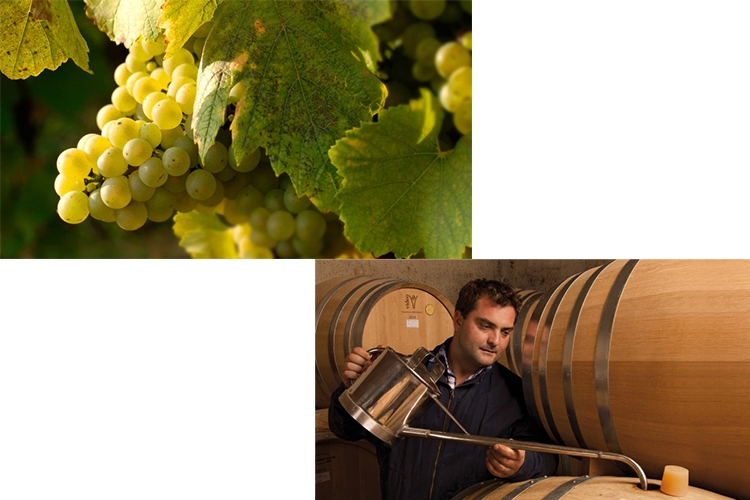
The estate itself was founded by Jean Guérin, who took over 4 hectares of share-cropped land from his father, Jules, and worked it for 45 years. Today the winery extends over 20 hectares and is owned and managed by Jean’s grandson and fourth generation vintner William Trouillet, who is helped by his mother (and Jean’s daughter) Marie-Agnès.  It is composed of vines in six villages that average 40-50-years-old planted in classic clay-limestone soils: Soluté-Pouilly, Fuissé, Loché, Vinzelles, Leynes, and Davayé.  The vines are grown sustainably, and tilling is largely carried out to encourage underground soil life and root development to obtain the richness and minerality required for the highest quality wines.
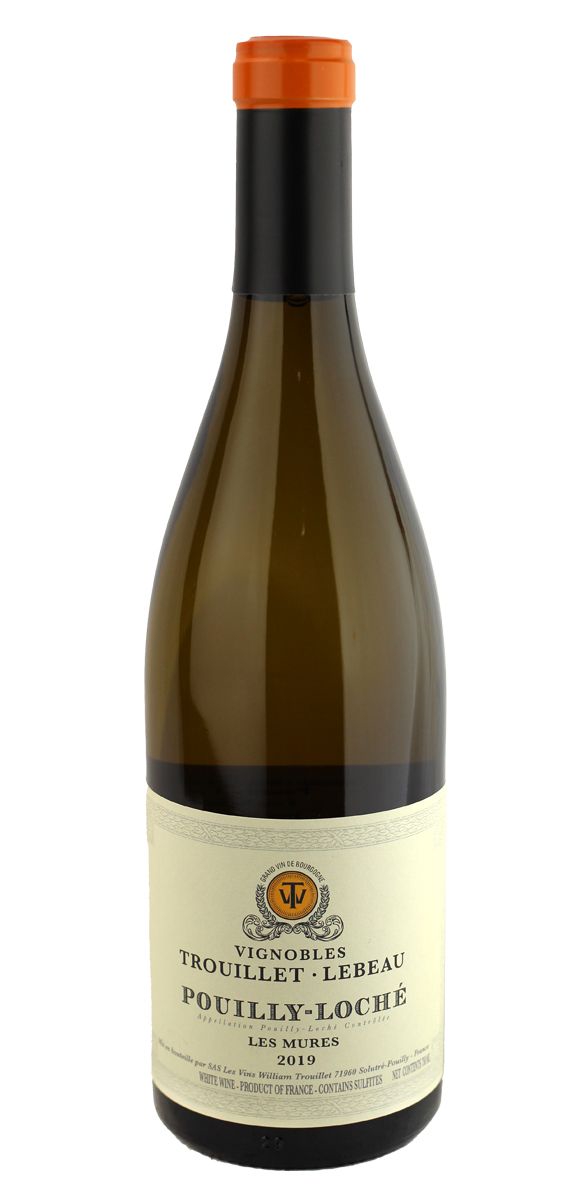
In the cellar, grapes are pressed gently using a pneumatic press and decanted rigorously for 24 hours, in order to obtain clear, pure grape juice. All vintages are vinified in oak vats, large barrels or casks from Burgundy, fully respecting the required cool temperatures in order to maintain all of the freshness and finesse of Chardonnay. The wines benefit from the exceptional terroir, which produces a wide range of dry and fruity wines with great complexity.  We told you that the Pouilly Aux Chailloux 2018 really lit us up.  So did the Trouillet-Lebeau Pouilly Loché Les Mures 2019, from their holdings in Pouilly Loché, next door to Pouilly Fuissé and one of the smallest zones in the region, encompassing a mere 33 hectares.

Pouilly Loché, the appellation, has existed since 1940.  But viticulture in this little jewel of a spot dates back to Roman times.  The ‘Les Mures’ vineyard lies on an east-facing hillside at 250 meters of elevation.  The vines here are 25 years old.  The grapes are harvested manually and aged in 100% French oak, 30% new.  It sees extended contact with the lees.  This vineyard wasn’t designated as a Premier Cru, but clearly the emerging superstar winemaker William Trouillet didn’t need a ‘title’ to ‘make magic’ here!

The nose shows precise yellow stone fruits with whiffs of spice and chalky minerality.  In the mouth, the fruit has breadth and weight, delivering on the promise of buoyant, perfectly ripe peach and apricot with a fine underpinning of lifting acidity and an insistent carry-through of the mineral tones, all ending with a hint of fine, wild herbs jumping on board at the finish.  A very tasty bottle of Chardonnay with surprising palate presence.  Because this isn’t a titled vineyard, it costs even less than the Chailloux and is easily one of the best Chardonnays we have has for under $25 in a long time.

It’s the kind of effort that will justify the recognition the area is having bestowed on it as well as showcase Trouillet Lebeau as a player in the ‘new order’.  Putting our money where our mouths are, we bought every box the purveyor had.  This drinks beautifully now and should develop further if one can leave it alone.  The price performance here is exceptional, and this stylish Chardonnay will definitely make a big impression.

Regardless of all of the political aspects of new Premier Cru status and the buzz it creates for the region, this producer is a marvelous discovery in and of itself.  Trouillet-Lebeau is still relatively unknown, though it has clearly proven to be one to follow.  It’s clear this label is going places and we suspect, given the performance of the few wines we have tasted (there was a stunning Saint Veran we bought as well), we don’t expect prices will stay the same much longer.  This is classy, complex Chardonnay of the highest order…at the lowest price.
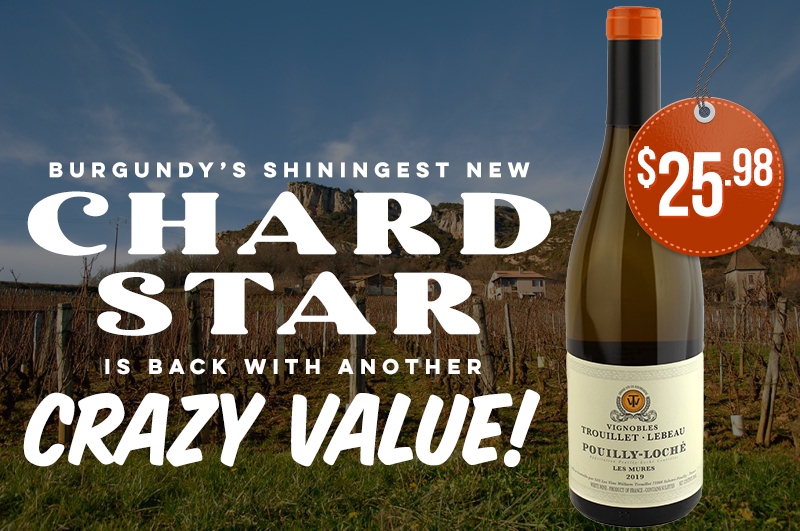
Trouillet-Lebeau Pouilly Loché Les Mures 2019
The nose shows precise yellow stone fruits with whiffs of spice and chalky minerality.  In the mouth, the fruit has breadth and weight, delivering on the promise of buoyant, perfectly ripe peach and apricot with a fine underpinning of lifting acidity and an insistent carry-through of the mineral tones, all ending with a hint of fine, wild herbs jumping on board at the finish.  A very tasty bottle of Chardonnay with surprising palate presence.  Because this isn’t a titled vineyard, it costs even less than the Chailloux and is easily one of the best Chardonnays we have has for under $25 in a long time. 
ONLY $25.98
COMPANY
© 2021 WINE EXCHANGE
CONTACT INFO
1544 East Warner Avenue, Santa Ana, CA 92705, USA
PHONE: 1-800-769-4639
FAX: 714-979-1520

{{Sender_Name}}

{{Sender_Address}}, {{Sender_City}}, {{Sender_State}} {{Sender_Zip}}

UnsubscribeUnsubscribe Preferences

DELICIOUS ‘SLEEPER’ BARBARESCO

Given our experience, we can tell you a thing or two about the big reds of Piedmont.  First, most folks are content to get into the game when a highly regarded vintage comes along.  Relative to that, as we are on the downside of the heralded 2016 vintage, you might want to take a last glance at the remaining 2016 Barolos and Barbarescos.  This was a special vintage even among the high success rate in Piedmont over the last decade or so.

We’d also point out that the producers make wine every year and not every harvest becomes a vintage of the century in the eyes of the market.  That doesn’t mean that there aren’t any worthwhile efforts, just that the ‘hit ratio’ might be a bit lower.  One can find some pretty thrilling wines in most vintages provided they take the time to look.  The Nada Barbaresco Casot 2018 is an excellent example of what we are talking about. 

It’s easy to miss little gems like this.  This is a small family estate is brought in by a small importer, and the 2018 vintage, while good, isn’t going to get the attention of, say, 2010, 2015, or 2016 from a ‘historic’ standpoint.  Still, we did our due diligence and were quite pleased to find this elegant, delightful little spice-box of a single vineyard-Barbaresco at a rather attractive price ( it sells for less than the entry-level bottling from Produttori di Barbaresco by $8).  As such, it deserves to get some of your attention.

Azienda Agricola Nada Giuseppe was started in 1900, with a vineyard in Casot purchased from a Gaja. In 1964 Giuseppe’s father, Antonio, made the risky decision to begin to estate bottle a part of his production, requiring him to invest in a small winery (he put it in the basement of that house on the Casot hillside). It was a prescient move as, in 1966, the DOC of Barbaresco, named after one of the three villages in the appellation, became established.

These days, Giuseppe and Nella stay fit maintaining the vineyards where they do practically all of the work, while their daughter Barbara manages the office and their son Enrico oversees the wine production down in the cellar. Enrico took the reins in 2008. The additions of SO2 have been greatly reduced and only a light filtration (no fining) is performed in the cellar. The farming has steadily moved to organic and most of the estate is certified organic now.

Packed with a high-toned, very Nebbiolo character, bursting with spicy red fruits and supported by fine but giving tannins, this Casot is an expressive and appealing example of the genre, exhibiting all of the best traits.  As the Wine Advocate review alludes, the appeal was definitely immediate but also lasting.  It can age, but it doesn’t necessarily need to.  The 2018 vintage overall is a lovely, round, accessible vintage that maybe doesn’t have the gravitas or media attention of 2016, but still should not be ignored because of wines like this. At this price, the Casot is a true sleeper.

From Monica Larner of Wine Advocate, “The 2018 Barbaresco Casot is a fragrant and immediate wine that shows a good amount of ripeness and richness up front. This was a cool vintage overall, although the fruit ripened quickly toward the end of the growing season. There are sweet cherry aromas with spice and licorice. The wine drapes over the palate with silky and smooth intensity. The Casot vineyard is distinguished by layers of bluish tufo soil and layers of looser sand…93 points.”

TERRES BLANCHES REVISITED

If the subject matter looks a little familiar, guilty as charged.  We sent this email on Les Terres Blaches in early October.  We reiterated our dismay with the natural wine movement in general, which we’ve mostly eliminated in this piece, and spent a good bit of type extolling these folks in the Anjou for making some of the cleanest, best, most exemplary natural wines we had ever come across.  There was no press at the time, and the interest admittedly disappointing.  Literally a couple of weeks later, Wine Advocate’s Stephan Reinhardt ‘went off’ on two of the four wines we highlighted in that piece (plus the prior vintage of the ‘pet-nat’).  We intend to send it out again with the Wine Advocate notes but the holiday email schedule is crammed and these wines deserve attention.  So, for the moment, here are our original comments with Reinhardt’s notes inserted. 

In 2004, Celine and Benoit took over the 8.5 hectare domaine of Bernard Coutel, who was retiring and had no family members to follow in his footsteps. Certified in Organic Agriculture since 2010, the Blets also work in the cellar to the rhythm of the wines. Their wines are the expression of the particular grape variety on the specific terroir as unfettered as possible.  Their mission is to produce grapes and develop natural wines while protecting their environment throughout the farm.   That synergy affects everything.  The estate is located in Anjou, in the Loire Valley.  The grapes varieties are Chenin Blanc and Cabernet Franc.  The vines are planted between 4,500 and 4,800 vines per hectare with natural grassing every other row, the other row is plowed after the harvest to bury the compost and maintained by hoeing the rest of the year.  It is very methodical. 

They refer to what they do as ‘peasant agriculture’, adhering to centuries old traditions that predated chemicals and machines.  In their words, “To offer you hand-sewn natural wines, we strive to produce beautiful ripe grapes.”  They are fanatics in the vineyards and you feel the energy and clarity of purpose in their wines.  Us proffering ‘natural wines’ will be shock to many.  But we aren’t pushing them because they are ‘natural’.  We are talking about Terres Blanches because the wines impressed the heck out of us.  These kids are on to something, and the wines are under $25.  

The Celine et Benoit Blet Les Terres Blanches Les 3 Poiriers Anjou Blanc 2019 is also 100% Chenin made from a later harvest of grapes from similar (or the same?) soils.  These ‘healthy, golden’ grapes were pressed into neutral barrels via gravity where they fermented slowly without SO2, and then bottled with no fining or filtration.  This subtle, complex Chenin reminds us of a top-notch Vouvray sec, except for the price.  Pear, peach, maybe a little orange, with well woven in, delicate minerality, sneakily complex and subtly captivating, this is a star.

From Wine Advocate, “From the second sorting of grapes picked in fully ripe and healthy condition at the end of September, the 2019 Anjou Chenin Les 3 Poiriers displays an intense yet refined and elegant bouquet of perfectly ripe Chenin Blanc grapes intermingled with very fine and refreshing, flinty, crystalline and lemony sandstone aromas. Medium to full-bodied, this is a concentrated, dense, intense and persistent Chenin with remarkable mineral tension and vitality. The wine fermented in two- to eight-year-old barrels, then was blended in July of the following year and bottled in September just before the 2020 harvest. This is an impressive, ripe, elegant and sustainable, well-structured and tensioned Chenin with excellent ripeness and concentration. A long-distance runner for sure. 14% alcohol. Tasted in June 2021…93 points.”

Like all of the others in this lineup, the Celine et Benoit Blet Les Terres Blanches Anjou Rouge Demon 2019 exudes great purity.  In keeping with the theme this 100% Cabernet Franc of a particular variety referred as ‘Breton’ that was originally planted by an abbot of that name.  It was harvested at optimum ripeness, destemmed, and given 5 weeks maceration then transferred to neutral (2-5 year old) barrels.  Bottled unfiltered and unfined, with no SO2, this exudes ripe Franc character of dark red and blue fruit, is tender on the palate and without any green of funky notes.  A gentle, engaging red that shows all the best sides of Cabernet Franc.  Celine and Benoit refer to their produce as enlightened peasant wine.   It seems the ‘peasants’ drink pretty well around these.

From Wine Advocate, “The 2019 Anjou Démon is from the Poulette parcels above the Hautes Bruyères and was completely destemmed before the infusion on the mash, which took one month. The bouquet is beautifully fine and elegant, with red and dark berry aromas, also cassis, along with crystalline stony notes. Smooth, refined and highly elegant on the palate, with perfectly ripe black berry fruit aromas and silky tannins, this is an intense and beautifully aromatic Cabernet Franc with outstanding finesse and balance. The tannins are marvelously refined and intermingled with the ripe and crystalline acidity, and the finish is ripe, long, sweet and balanced. A fabulous wine. Tasted in June 2021… 93+ points.”

In closing, we didn’t buy these because they were ‘natural’, but because they were really good, well priced, and quite distinctive.   The fact that they were ‘natural’ had zero effect on our decision.  The fact that wines this clean and expressive could be made that way was something of a revelation given our experience with the natural wine category.  Clearly these kids are working hard and, in our eyes, setting an example.  These aren’t wines particularly targeted for ‘natural wine’ buffs.  These stylish, energetic wines are for anyone!