

A roadmap to the wine world’s most common seasonal scenarios
Yes, it is that time of year. As you may have seen, we typically put out something of a guideline for wines for Thanksgiving, taking into account very general scenarios and offering suggestions as to what to serve. This time around, we thought it might be helpful to toss out a few suggestions based on the questions we seem to get every holiday season. Of course, it would be impossible to comment on every potential situation, probably even foolhardy. But we do encounter things based on our experience that might not cross your mind during the busy season until it happens. So, we’ll put it out there and hope it might give you some confidence in navigating your holiday milieu.
The Big Event
Everyone has their own take on the ‘big days’ and how they celebrate one day vs. another. Ours is not to comment on that, but rather look at a few ways that people celebrate. For the record, we know that there are many modern cultural takes on holiday food and holiday traditions. For the sake of this article we will be discussing more broad seasonal scenarios with traditional American holiday cuisine. With that said, three ways we can think of celebrating a big day might include a full sit-down dinner, something with more substantial hors d’oeuvres, or a more pass-through visitation like an open-house type with lighter nibbles. Each one calls for a little different lineup of beverages specific not only to the type of event but what kinds of foods you’re offering.
Sit Down Dinner
A lot depends on the main course with the wine selections. We figure more popular choices might end up being ham, some sort of bird (turkey, goose, capon), or some sort of meat (beef, lamb) with an array of sides, though there are of course many other options. With ham, play against the saltiness with white wine that has crisp acidity and is light on its feet.
A little residual sugar adds to the match. Our first go-tos with ham would be Riesling or Chenin Blanc, or lighter whites like Pinot Gris, Pinot Blanc, Sauvignon Blanc, or for the more adventurous, Italian whites from the northeast like Kerner or Friulano. You want something crisp, clean, and not oaky. For reds, think about Beaujolais, Pinot Noir, Rioja or Dolcetto, lighter, brighter reds that aren’t tannic or too woody.
Our choices for some sort of bird would be pretty much the same for the same reason. Heavy reds and whites don’t really augment the food and can become tiresome over the course of the meal. If you want to serve some powerhouse red with the bird, that is of course your business, but it’s not what we’d choose.
For Whites Check out:

Celine et Benoit Blet Les Terres Blanches Anjou Blanc Les 3 Poiriers 2020

Franz Gojer Kerner Karneid Alto Adige 2020

For Reds Check out:

Domaine de la Madone Beaujolais Villages Bio 2020

Luigi Einaudi Dogliani 2021
Finally, if we’re looking at roast beef, standing rib roast, rack of lamb or some such, bring on the big reds. Red Bordeaux, Cabernet, Chateauneuf du Pape, Syrah, Barolo, or authoritative Tuscan all play well, as do a variety of things from Spain. If you’re having budget concerns, there are excellent lower priced options in every category (like instead of Chateauneuf, sub in a solid Cotes du Rhone).
Check out:

Coufran Haut Medoc 2009

Domaine de la Charbonniere Chateauneuf Du Pape Cuvee Vieilles Vignes 2019

Podernuovo A Palazzone Toscana Argirio 2016

Heavy Hors D’Ouerves or Tapas
A lot depends on your choice of dishes, of course. But again, we’d caution to stay away from heavier wines. Also, the standup or more social scenario kind of dials back the price need because folks are less likely to note extra complexity you would pay a lot extra for. Not to mention the party might stay a little livelier if you ditch the big ponderous wines.
Our whites list remains pretty much unchanged from the last section. For reds, again Beaujolais, Pinot Noir, Chianti, Cotes du Rhone, a number of things from Spain, the goal is fruit-forward, outgoing, tasty, and not too tannic or heavy.
White:

Domaine Weinbach Pinot Gris Cuvée Ste. Catherine 2020

Red:

Zorzal Pinot Noir Terroir Unico 2019
Open House with Lighter Fare
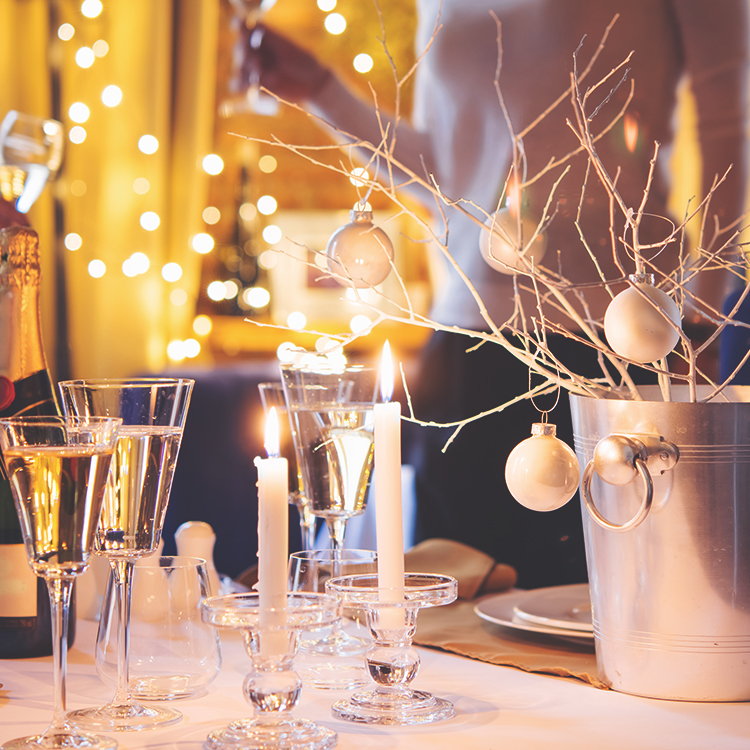
The rules really don’t change a lot for reds and whites, but we see this as a great opportunity to sprinkle in some sparkling wines. Most folks like bubbles and there’s good fizz at virtually all price ranges, from Cavas like Poema ($9.98) and Conquilla ($10.98) to Prosecco to Crémant de Bourgogne to Champagne.
If you’ve got folks that don’t like dry, offer the Bottex Bugey-Cerdon, a sweeter, sparkling red from the Savoie that is a revelation for some (we’ve heard it inelegantly referred to as “adult Kool-aid” and we’re not necessarily disagreeing).
Others to check out:

Clos Cazals Brut Blanc De Blancs Grand Cru Cuvee Vive NV

Francis Orban Extra Brut Rosé NV

Santome Prosecco Extra Dry
The Holiday Essentials
For some people the holidays are a time a time of festivities, but also impromptu drop-bys. We suspect most folks will have stocks of favorite go-to reds and whites on hand, which we’d recommend keeping in line with our general food suggestions… outgoing, fresher styles that are fairly versatile. Lighter, brighter reds and crisper, unencumbered whites are always appropriate. But a couple of other categories can serve specific scenarios.
- Sparkling wines are widely popular and, in some folk’s minds create instant festivities. No matter where you might be comfortable price wise, there will be some bubbles to fill that need. We are as picky about our sparklers as we are everything else. No one at ‘corporate’ tells us what to sell because there is no ‘corporate’. We own it and are meticulous about our process at every level. As we mentioned in our open house piece, there are hand-picked (OK, mouth picked) choices at every level from about $11 on up. We have French Champagnes in the $20s. So there is something for everyone. But if it is on hand, all the better for the kind of spontaneity that can create memorable evenings.
- If you have a lot of traffic at your place during the holidays, you might end up with a few open bottles that don’t have a definite schedule and, of course, oxygenation is a reasonable concern. You could serve via something like a Coravin wine preservation device, but the device itself and the argon gas cartridges are somewhat costly. While it might be off of some people’s ‘beaten path,’ things like Sherry and Madeira are wines where you can pour someone a polite glass put it back in the cabinet and open it again in a week or two without fear. The wine will be unchanged. For perspective we did Sherry/Madeira tasting years ago that, thanks to weather, wasn’t well attended. We did the same tasting a year later…with the same bottles.
Madeiras, the wine of our forefathers like Washington and Jefferson, are pretty much bullet-proof and the drier versions like Sercial and Verdelho are fine aperitifs while the more dessert styles Buals and Malmseys are great choice to break the chill after an evening of caroling or looking at Xmas lights. They are fortified but the alcohol isn’t any more than a typical mixed cocktail.
As for Sherries, Finos and Manzanilla are lighter and drier, but will be more affected by oxygen over time. Amontillados, Palo Cortados, and Olorosos will hold it together for quite a while since they are produced via oxidation. And no, it isn’t weird. They are much trendier today than they were a decade ago and many restaurants now have Sherry programs and you’ll frequently see the, as ingredients in the trendiest cocktails as well. All benefit from a slight chill when serving but it isn’t mandatory.
Check out our in stock Sherries, Ports and Madeira HERE
Holiday Work Parties

As to general guidelines, we’ll stick pretty much to our answers on prior subjects. Easy drinking, medium weight reds and crisp whites again work best, fruit forward, fairly supple, maybe a little lower in acid. We’re going to recommend imports from Spain (the land of tapas bars), France (where bistros were born), and Italy (trattoria country), because we have found their wines purer and less manipulated, and these are places with established food and wine cultures. You can simply get more compelling wines in lower price ranges. For our money you can get much more from many parts of Spain, the southern Rhone and Languedoc, Beaujolais, and northern Italy as more specific categories.
BTW we’re not anti-American by any means, but we find that usually domestic wines produced to sell at lower price points are manipulated to achieve some sort of ‘control group’ personality and lesser fruit is taken in to keep costs down. Of course, there are exceptions, but you are less likely to find them at some chain store that is more concerned with ‘national best sellers’.
Check out:
Mas de Daumas Gassac IGP Pays d’Hérault Pont de Gassac 2021
Petra Unger Grüner Veltliner Gottschelle 2020
Host Gift

Let’s say you are invited somewhere, and you don’t want to show up empty handed, and decide you’d like to bring something vinous. Of course, it’s OK to present your hosts with something you favor, or something you already know they like. But what if you have no idea what they like? Plus, if you show up with something red, are you expecting that they will open it while you are there? Our suggestion is to show up with some properly wrapped (a festive bag will do), un-chilled sparkling wine. That alleviates the question of whether they are expected to open it, and we have run across very few people who are averse to Champagne. Also, during the season, there are likely many scenarios where a bottle of fizz will come in handy for the recipient. Win-Win.
Check out:
André Robert Extra Brut Blanc de Blancs Les Jardins du Mesnil NV
Boss’ Gift
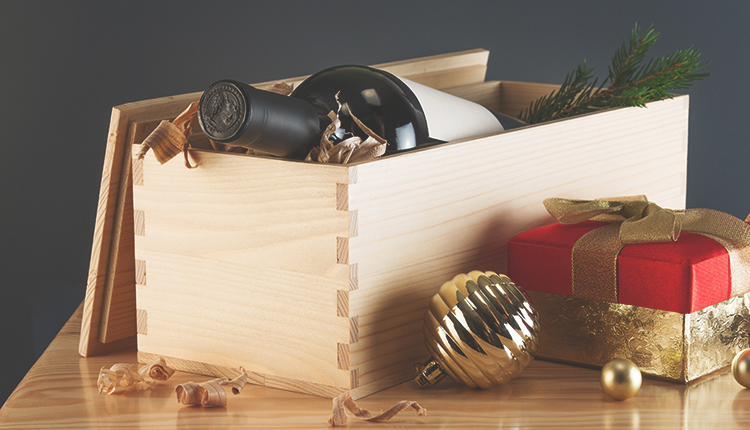
Every holiday season we get a number of people who are seeking to buy something for a co-worker, manager or employer. The whole process can be somewhat traumatic for people who don’t really know anything about wine, and it is unfortunate that those folks will likely not see our simple suggestions which might ease their process. Any good merchant is going to ask what you want to spend for the gift so have a real idea ahead of time what you are comfortable with budget-wise. Whatever that number is we’ll get as close as we can or explain why we can’t. We’re here to help you and the numbers are merely guidelines.
That said, there are a few scenarios. If you are pretty sure if the recipient is knowledgeable and you know specifics or even the genre, that helps. If you don’t, for an alleged knowledgeable recipient, the safe bets would be a classified Bordeaux or Napa/Sonoma Cabernet. The ‘prestige’ of the categories can drive prices up well into the three digits, particularly if you want something widely known like Harlan, Opus One, or even BV Georges Latour. There are high quality choices in lower price rungs that that will show beautifully in the glass but may not have the immediate label panache because they aren’t as widely distributed or been around as long. Knowledge and track record create fame but fame costs money, sometimes to the point of silliness (a bottle of Coche-Dury Corton Charlemagne costs over $6,000). Quality doesn’t have to.
If you want to present them a nice bottle but don’t really know anything about their tastes, we’re going to once again suggest Champagne. Sensing a trend there? There’s good reason though. It’s a pretty universal equalizer and there are many scenarios during the holidays when a nice bottle of Champs can come in handy, and the bubbly producers know that. That’s why there is a fight for placements in the industry. That’s a whole different story, but the point is that bubbly is a great solution for a wide range of situations.
Check out:

Laurent Perrier Brut Grand Siecle #25 NV

Overture by Opus One Napa Valley

Mayacamas Cabernet Sauvignon Mount Veeder 2018

La Gomerie Saint Emilion 2001
Bubbles…for the Holidays & Beyond

As we have said repeatedly, we consider Champagne an excellent choice all the time, not just for festivities. But there is no denying that a little fizz can make a celebration better. Here again we’ll make the point that better known labels are better known because of history and, mainly, marketing. Marketing costs money. So you’ll pay more for label recognition and likely not get as good a Champagne on a value basis. That doesn’t mean that the big brands are ‘bad’. Our point is that, particularly with big Champagne houses, prices are being deliberately pushed upward for marketing reasons. They all want to be the wine versions of Louis Vuitton or Prada from an image standpoint. To us that means look elsewhere.
We’ve been on the bandwagon of small production grower Champagnes for decades because you typically get better and more intriguing juice (thanks to the terroir factor) for a better price (because the shipping channels are less encumbered with extraneous markups). It is impossible to replace the elements of terroir and small production as they manifest in the finished wine. To that end, here are a few recommendations in various categories.
At the top end of the spectrum, there are always those highly visible labels like Dom Perignon that are reenforced by a long history and appearances in movies and TV shows. The label will impress your friends but prices are much more than they used to be and they make a million bottles of the stuff. For less money we have top-flight boutique offerings from cool kid sources like the structured, precise, distinctive Egly-Ouriet Brut Tradition Grand Cru NV ($109.98) and Doyard Extra Brut Blanc de Blancs Grand Cru 2009 ($129.98 both done in an extra brut style from Grand Cru vineyards.
For about what you’d pay for something like Clicquot in a big box score (or less) we have distinctive, soulful choices from smaller houses. We’ve talked about the Clos Cazals Brut Blanc De Blancs Grand Cru Cuvee Vive NV ($59.98) from remarkably elite estate vineyards in the Cote Blanc, and the André Robert Extra Brut Blanc de Blancs Les Jardins du Mesnil NV ($59.98) also from Mesnil, the other great village in the Cote Blanc.
For less than you’d pay for those more commercial labels the mouth-filling, Pinot Meunier based Francis Orban Extra Brut NV ($39.98) is back and we’re keen on a couple more recent discoveries, the Caillez Lemaire Extra Brut Reflets NV ($54.98) and the fine-lined, 70% Chardonnay Gonet-Médeville Brut 1er Cru Tradition NV ($44.98).
Drop down a few more dollars and there’s still plenty of good stuff Champagne-wise. The Champagne Charles Le Bel Brut Inspiration 1818 NV ($32.98) is pretty new to us but is the second wine of Champagne heavyweight Billecart Salmon and reflect the creamy house style as well as being a stellar value. Back in the saddle again is the Emile Paris, who reintroduced the brand after a 75 year layoff using their estate grapes that were being sold to Philipponat. Another striking value in real French Champagne.
If you’re looking for great sparkling wines and don’t care if they actually say Champagne on them, here are a couple of unique selections for the more adventurous. The Chateau de Brézé Crémant de Loire NV ($24.98) is a 70% Chenin Blanc/30% Chardonnay blend from a special estate in the Loire Valley that can hang with any Champagne but has a unique, fruit driven element thanks to that Chenin. Occasionally we’ll find something very cool from unexpected places. The Jean Vullien Crémant de Savoie Brut NV ($17.98) is a unique blend of 50% Jacquere, 30% Chardonnay, and 20% Altesse, this has a fine minerally texture and a very food friendly personality along with fine bubbles and creamy mousse of a classic sparkler.