The Stock Report Guide to the Holidays

A roadmap to the wine world’s most common seasonal scenarios

Yes, it is that time of year.  As you may have seen, we typically put out something of a guideline for wines for Thanksgiving, taking into account very general scenarios and offering suggestions as to what to serve.   This time around, we thought it might be helpful to toss out a few suggestions based on the questions we seem to get every holiday season.  Of course, it would be impossible to comment on every potential situation, probably even foolhardy.  But we do encounter things based on our experience that might not cross your mind during the busy season until it happens.  So, we’ll put it out there and hope it might give you some confidence in navigating your holiday milieu.

The Big Event

Everyone has their own take on the ‘big days’ and how they celebrate one day vs. another. Ours is not to comment on that, but rather look at a few ways that people celebrate. For the record, we know that there are many modern cultural takes on holiday food and holiday traditions. For the sake of this article we will be discussing more broad seasonal scenarios with traditional American holiday cuisine.  With that said, three ways we can think of celebrating a big day might include a full sit-down dinner, something with more substantial hors d’oeuvres, or a more pass-through visitation like an open-house type with lighter nibbles.  Each one calls for a little different lineup of beverages specific not only to the type of event but what kinds of foods you’re offering.
Sit Down Dinner
A lot depends on the main course with the wine selections.  We figure more popular choices might end up being ham, some sort of bird (turkey, goose, capon), or some sort of meat (beef, lamb) with an array of sides, though there are of course many other options.  With ham, play against the saltiness with white wine that has crisp acidity and is light on its feet. 

A little residual sugar adds to the match.  Our first go-tos with ham would be Riesling or Chenin Blanc, or lighter whites like Pinot Gris, Pinot Blanc, Sauvignon Blanc, or for the more adventurous, Italian whites from the northeast like Kerner or Friulano.  You want something crisp, clean, and not oaky.  For reds, think about Beaujolais, Pinot Noir, Rioja or Dolcetto, lighter, brighter reds that aren’t tannic or too woody.

Our choices for some sort of bird would be pretty much the same for the same reason.  Heavy reds and whites don’t really augment the food and can become tiresome over the course of the meal.  If you want to serve some powerhouse red with the bird, that is of course your business, but it’s not what we’d choose.

For Whites Check out: 

Celine et Benoit Blet Les Terres Blanches Anjou Blanc Les 3 Poiriers 2020

Franz Gojer Kerner Karneid Alto Adige 2020

For Reds Check out:

Domaine de la Madone Beaujolais Villages Bio 2020

Luigi Einaudi Dogliani 2021

Finally, if we’re looking at roast beef, standing rib roast, rack of lamb or some such, bring on the big reds.  Red Bordeaux, Cabernet, Chateauneuf du Pape, Syrah, Barolo, or authoritative Tuscan all play well, as do a variety of things from Spain.  If you’re having budget concerns, there are excellent lower priced options in every category (like instead of Chateauneuf, sub in a solid Cotes du Rhone).

Check out:

Coufran Haut Medoc 2009

Domaine de la Charbonniere Chateauneuf Du Pape Cuvee Vieilles Vignes 2019

Podernuovo A Palazzone Toscana Argirio 2016

Heavy Hors D’Ouerves or Tapas
A lot depends on your choice of dishes, of course.  But again, we’d caution to stay away from heavier wines.  Also, the standup or more social scenario kind of dials back the price need because folks are less likely to note extra complexity you would pay a lot extra for. Not to mention the party might stay a little livelier if you ditch the big ponderous wines.

Our whites list remains pretty much unchanged from the last section.  For reds, again Beaujolais, Pinot Noir, Chianti, Cotes du Rhone, a number of things from Spain, the goal is fruit-forward, outgoing, tasty, and not too tannic or heavy.

White:

Domaine Weinbach Pinot Gris Cuvée Ste. Catherine 2020

Red:

Zorzal Pinot Noir Terroir Unico 2019

Open House with Lighter Fare
The rules really don’t change a lot for reds and whites, but we see this as a great opportunity to sprinkle in some sparkling wines.  Most folks like bubbles and there’s good fizz at virtually all price ranges, from Cavas like Poema ($9.98) and Conquilla ($10.98) to Prosecco to Crémant de Bourgogne to Champagne. 

If you’ve got folks that don’t like dry, offer the Bottex Bugey-Cerdon, a sweeter, sparkling red from the Savoie that is a revelation for some (we’ve heard it inelegantly referred to as “adult Kool-aid” and we’re not necessarily disagreeing).

Others to check out:

Clos Cazals Brut Blanc De Blancs Grand Cru Cuvee Vive NV

Francis Orban Extra Brut Rosé NV

Santome Prosecco Extra Dry

The Holiday Essentials

For some people the holidays are a time a time of festivities, but also impromptu drop-bys.  We suspect most folks will have stocks of favorite go-to reds and whites on hand, which we’d recommend keeping in line with our general food suggestions… outgoing, fresher styles that are fairly versatile.   Lighter, brighter reds and crisper, unencumbered whites are always appropriate.  But a couple of other categories can serve specific scenarios. 

  • Sparkling wines are widely popular and, in some folk’s minds create instant festivities.  No matter where you might be comfortable price wise, there will be some bubbles to fill that need.  We are as picky about our sparklers as we are everything else.  No one at ‘corporate’ tells us what to sell because there is no ‘corporate’.  We own it and are meticulous about our process at every level.  As we mentioned in our open house piece, there are hand-picked (OK, mouth picked) choices at every level from about $11 on up.  We have French Champagnes in the $20s.  So there is something for everyone.  But if it is on hand, all the better for the kind of spontaneity that can create memorable evenings.
  • If you have a lot of traffic at your place during the holidays, you might end up with a few open bottles that don’t have a definite schedule and, of course, oxygenation is a reasonable concern.   You could serve via something like a Coravin wine preservation device, but the device itself and the argon gas cartridges are somewhat costly.  While it might be off of some people’s ‘beaten path,’ things like Sherry and Madeira are wines where you can pour someone a polite glass put it back in the cabinet and open it again in a week or two without fear.  The wine will be unchanged. For perspective we did Sherry/Madeira tasting years ago that, thanks to weather, wasn’t well attended.  We did the same tasting a year later…with the same bottles.
Madeiras, the wine of our forefathers like Washington and Jefferson, are pretty much bullet-proof and the drier versions like Sercial and Verdelho are fine aperitifs while the more dessert styles Buals and Malmseys are great choice to break the chill after an evening of caroling or looking at Xmas lights.  They are fortified but the alcohol isn’t any more than a typical mixed cocktail. 
As for Sherries, Finos and Manzanilla are lighter and drier, but will be more affected by oxygen over time.  Amontillados, Palo Cortados, and Olorosos will hold it together for quite a while since they are produced via oxidation.  And no, it isn’t weird. They are much trendier today than they were a decade ago and many restaurants now have Sherry programs and you’ll frequently see the, as ingredients in the trendiest cocktails as well.  All benefit from a slight chill when serving but it isn’t mandatory.

Check out our in stock Sherries, Ports and Madeira HERE

Holiday Work Parties

As to general guidelines, we’ll stick pretty much to our answers on prior subjects.  Easy drinking, medium weight reds and crisp whites again work best, fruit forward, fairly supple, maybe a little lower in acid.  We’re going to recommend imports from Spain (the land of tapas bars), France (where bistros were born), and Italy (trattoria country), because we have found their wines purer and less manipulated, and these are places with established food and wine cultures.  You can simply get more compelling wines in lower price ranges.  For our money you can get much more from many parts of Spain, the southern Rhone and Languedoc, Beaujolais, and northern Italy as more specific categories.

BTW we’re not anti-American by any means, but we find that usually domestic wines produced to sell at lower price points are manipulated to achieve some sort of ‘control group’ personality and lesser fruit is taken in to keep costs down.  Of course, there are exceptions, but you are less likely to find them at some chain store that is more concerned with ‘national best sellers’.

Check out:

Mas de Daumas Gassac IGP Pays d’Hérault Pont de Gassac 2021

Petra Unger Grüner Veltliner Gottschelle 2020

Host Gift

Let’s say you are invited somewhere, and you don’t want to show up empty handed, and decide you’d like to bring something vinous.  Of course, it’s OK to present your hosts with something you favor, or something you already know they like.  But what if you have no idea what they like?  Plus, if you show up with something red, are you expecting that they will open it while you are there?  Our suggestion is to show up with some properly wrapped (a festive bag will do), un-chilled sparkling wine.  That alleviates the question of whether they are expected to open it, and we have run across very few people who are averse to Champagne.  Also, during the season, there are likely many scenarios where a bottle of fizz will come in handy for the recipient. Win-Win.

Check out:

André Robert Extra Brut Blanc de Blancs Les Jardins du Mesnil NV

Boss’ Gift
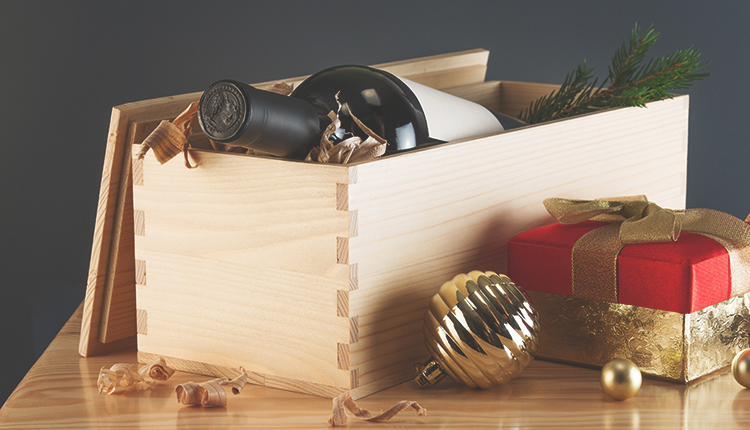
Every holiday season we get a number of people who are seeking to buy something for a co-worker, manager or employer.  The whole process can be somewhat traumatic for people who don’t really know anything about wine, and it is unfortunate that those folks will likely not see our simple suggestions which might ease their process.  Any good merchant is going to ask what you want to spend for the gift so have a real idea ahead of time what you are comfortable with budget-wise.  Whatever that number is we’ll get as close as we can or explain why we can’t.  We’re here to help you and the numbers are merely guidelines.

That said, there are a few scenarios.  If you are pretty sure if the recipient is knowledgeable and you know specifics or even the genre, that helps.  If you don’t, for an alleged knowledgeable recipient, the safe bets would be a classified Bordeaux or Napa/Sonoma Cabernet.  The ‘prestige’ of the categories can drive prices up well into the three digits, particularly if you want something widely known like Harlan, Opus One, or even BV Georges Latour.  There are high quality choices in lower price rungs that that will show beautifully in the glass but may not have the immediate label panache because they aren’t as widely distributed or been around as long.  Knowledge and track record create fame but fame costs money, sometimes to the point of silliness (a bottle of Coche-Dury Corton Charlemagne costs over $6,000).  Quality doesn’t have to.

If you want to present them a nice bottle but don’t really know anything about their tastes, we’re going to once again suggest Champagne. Sensing a trend there? There’s good reason though. It’s a pretty universal equalizer and there are many scenarios during the holidays when a nice bottle of Champs can come in handy, and the bubbly producers know that.  That’s why there is a fight for placements in the industry.  That’s a whole different story, but the point is that bubbly is a great solution for a wide range of situations. 

Check out:

Laurent Perrier Brut Grand Siecle #25 NV

Overture by Opus One Napa Valley

Mayacamas Cabernet Sauvignon Mount Veeder 2018

La Gomerie Saint Emilion 2001

Bubbles…for the Holidays & Beyond

As we have said repeatedly, we consider Champagne an excellent choice all the time, not just for festivities.  But there is no denying that a little fizz can make a celebration better.  Here again we’ll make the point that better known labels are better known because of history and, mainly, marketing.  Marketing costs money.  So you’ll pay more for label recognition and likely not get as good a Champagne on a value basis.  That doesn’t mean that the big brands are ‘bad’. Our point is that, particularly with big Champagne houses, prices are being deliberately pushed upward for marketing reasons.  They all want to be the wine versions of Louis Vuitton or Prada from an image standpoint.  To us that means look elsewhere.

We’ve been on the bandwagon of small production grower Champagnes for decades because you typically get better and more intriguing juice (thanks to the terroir factor) for a better price (because the shipping channels are less encumbered with extraneous markups).  It is impossible to replace the elements of terroir and small production as they manifest in the finished wine.  To that end, here are a few recommendations in various categories.

At the top end of the spectrum, there are always those highly visible labels like Dom Perignon that are reenforced by a long history and appearances in movies and TV shows.  The label will impress your friends but prices are much more than they used to be and they make a million bottles of the stuff.  For less money we have top-flight boutique offerings from cool kid sources like the structured, precise, distinctive Egly-Ouriet Brut Tradition Grand Cru NV ($109.98) and Doyard Extra Brut Blanc de Blancs Grand Cru 2009 ($129.98 both done in an extra brut style from Grand Cru vineyards.

For about what you’d pay for something like Clicquot in a big box score (or less) we have distinctive, soulful choices from smaller houses.   We’ve talked about the Clos Cazals Brut Blanc De Blancs Grand Cru Cuvee Vive NV ($59.98) from remarkably elite estate vineyards in the Cote Blanc, and the André Robert Extra Brut Blanc de Blancs Les Jardins du Mesnil NV ($59.98) also from Mesnil, the other great village in the Cote Blanc.

For less than you’d pay for those more commercial labels the mouth-filling, Pinot Meunier based Francis Orban Extra Brut NV ($39.98) is back and we’re keen on a couple more recent discoveries, the Caillez Lemaire Extra Brut Reflets NV ($54.98) and the fine-lined, 70% Chardonnay Gonet-Médeville Brut 1er Cru Tradition NV ($44.98).

Drop down a few more dollars and there’s still plenty of good stuff Champagne-wise.  The Champagne Charles Le Bel Brut Inspiration 1818 NV ($32.98) is pretty new to us but is the second wine of Champagne heavyweight Billecart Salmon and reflect the creamy house style as well as being a stellar value.  Back in the saddle again is the Emile Paris, who reintroduced the brand after a 75 year layoff using their estate grapes that were being sold to Philipponat.  Another striking value in real French Champagne.

If you’re looking for great sparkling wines and don’t care if they actually say Champagne on them, here are a couple of unique selections for the more adventurous.  The Chateau de Brézé Crémant de Loire NV ($24.98) is a 70% Chenin Blanc/30% Chardonnay blend from a special estate in the Loire Valley that can hang with any Champagne but has a unique, fruit driven element thanks to that Chenin.  Occasionally we’ll find something very cool from unexpected places. The Jean Vullien Crémant de Savoie Brut NV ($17.98) is a unique blend of 50% Jacquere, 30% Chardonnay, and 20% Altesse, this has a fine minerally texture and a very food friendly personality along with fine bubbles and creamy mousse of a classic sparkler.

Another Sensational Chardonnay Steal from this Soon-To-Be 1er Cru!

To all Wine Exchangers,

Like many of you, we love Burgundy.  So, it truly exciting that a new, passionate, dedicated generation has taken hold and among them are a number of vignerons committed to raising the bar.  Today’s latest offering from one of the most exciting new Chardonnay crafters on the planet being a wonderful case in point.

We did an offer not too long ago talking about the new Premier Cru designations in Pouilly Fuissé that would surely elevate the status (and probably the prices) of this long-respected region.  In a sense, like we said in that offer, it’s kind of like getting a stock tip, except that everybody knows it’s going to happen.  It just hasn’t happened yet.  Officially, started in the vintage 2020, the climats that were designated can bear the title Premier Cru.  

To illustrate the point, we offered out a brilliant effort from a site, one of 22, that was given the new Premier Cru designation, Pouilly Fuisse Aux Chailloux, from a relatively unknown estate named Trouillet-Lebeau.  That Chardonnay had it all, great fruit, terroir, complexity and structure.  It was a riveting bottle of white wine. Today we are offering another wine from that same estate and arguably one of the most engaging Chardonnay values we’ve tasted this year.

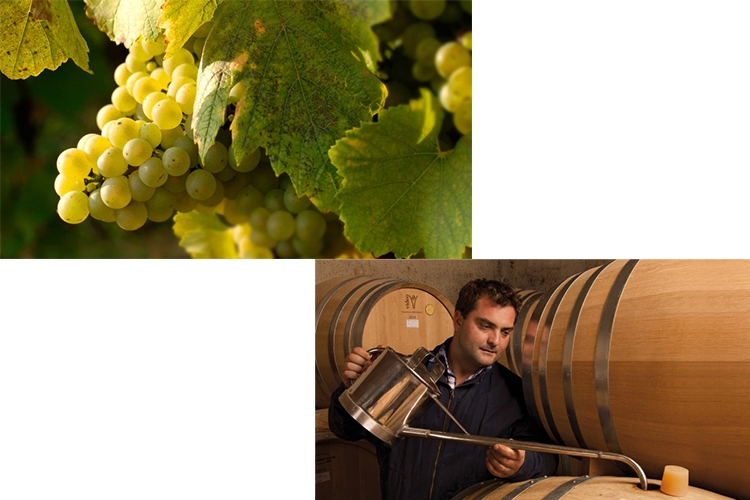
The estate itself was founded by Jean Guérin, who took over 4 hectares of share-cropped land from his father, Jules, and worked it for 45 years. Today the winery extends over 20 hectares and is owned and managed by Jean’s grandson and fourth generation vintner William Trouillet, who is helped by his mother (and Jean’s daughter) Marie-Agnès.  It is composed of vines in six villages that average 40-50-years-old planted in classic clay-limestone soils: Soluté-Pouilly, Fuissé, Loché, Vinzelles, Leynes, and Davayé.  The vines are grown sustainably, and tilling is largely carried out to encourage underground soil life and root development to obtain the richness and minerality required for the highest quality wines.
In the cellar, grapes are pressed gently using a pneumatic press and decanted rigorously for 24 hours, in order to obtain clear, pure grape juice. All vintages are vinified in oak vats, large barrels or casks from Burgundy, fully respecting the required cool temperatures in order to maintain all of the freshness and finesse of Chardonnay. The wines benefit from the exceptional terroir, which produces a wide range of dry and fruity wines with great complexity.  We told you that the Pouilly Aux Chailloux 2018 really lit us up.  So did the Trouillet-Lebeau Pouilly Loché Les Mures 2019, from their holdings in Pouilly Loché, next door to Pouilly Fuissé and one of the smallest zones in the region, encompassing a mere 33 hectares.

Pouilly Loché, the appellation, has existed since 1940.  But viticulture in this little jewel of a spot dates back to Roman times.  The ‘Les Mures’ vineyard lies on an east-facing hillside at 250 meters of elevation.  The vines here are 25 years old.  The grapes are harvested manually and aged in 100% French oak, 30% new.  It sees extended contact with the lees.  This vineyard wasn’t designated as a Premier Cru, but clearly the emerging superstar winemaker William Trouillet didn’t need a ‘title’ to ‘make magic’ here!

The nose shows precise yellow stone fruits with whiffs of spice and chalky minerality.  In the mouth, the fruit has breadth and weight, delivering on the promise of buoyant, perfectly ripe peach and apricot with a fine underpinning of lifting acidity and an insistent carry-through of the mineral tones, all ending with a hint of fine, wild herbs jumping on board at the finish.  A very tasty bottle of Chardonnay with surprising palate presence.  Because this isn’t a titled vineyard, it costs even less than the Chailloux and is easily one of the best Chardonnays we have has for under $25 in a long time.

It’s the kind of effort that will justify the recognition the area is having bestowed on it as well as showcase Trouillet Lebeau as a player in the ‘new order’.  Putting our money where our mouths are, we bought every box the purveyor had.  This drinks beautifully now and should develop further if one can leave it alone.  The price performance here is exceptional, and this stylish Chardonnay will definitely make a big impression.

Regardless of all of the political aspects of new Premier Cru status and the buzz it creates for the region, this producer is a marvelous discovery in and of itself.  Trouillet-Lebeau is still relatively unknown, though it has clearly proven to be one to follow.  It’s clear this label is going places and we suspect, given the performance of the few wines we have tasted (there was a stunning Saint Veran we bought as well), we don’t expect prices will stay the same much longer.  This is classy, complex Chardonnay of the highest order…at the lowest price.
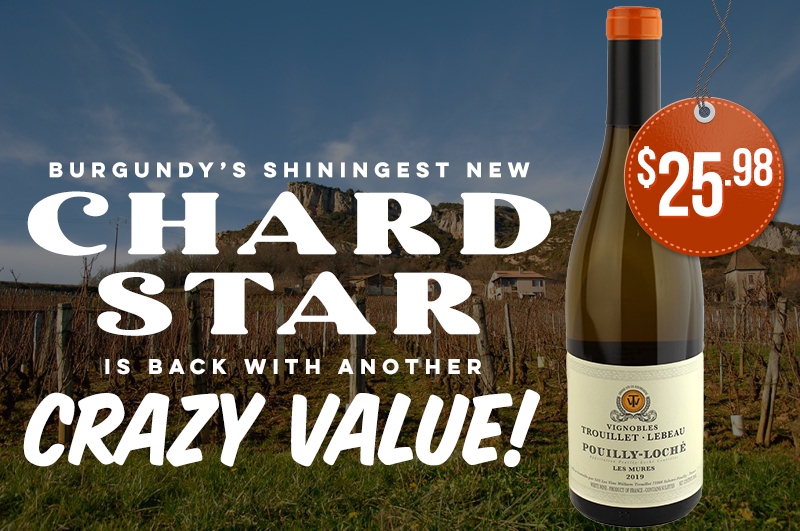
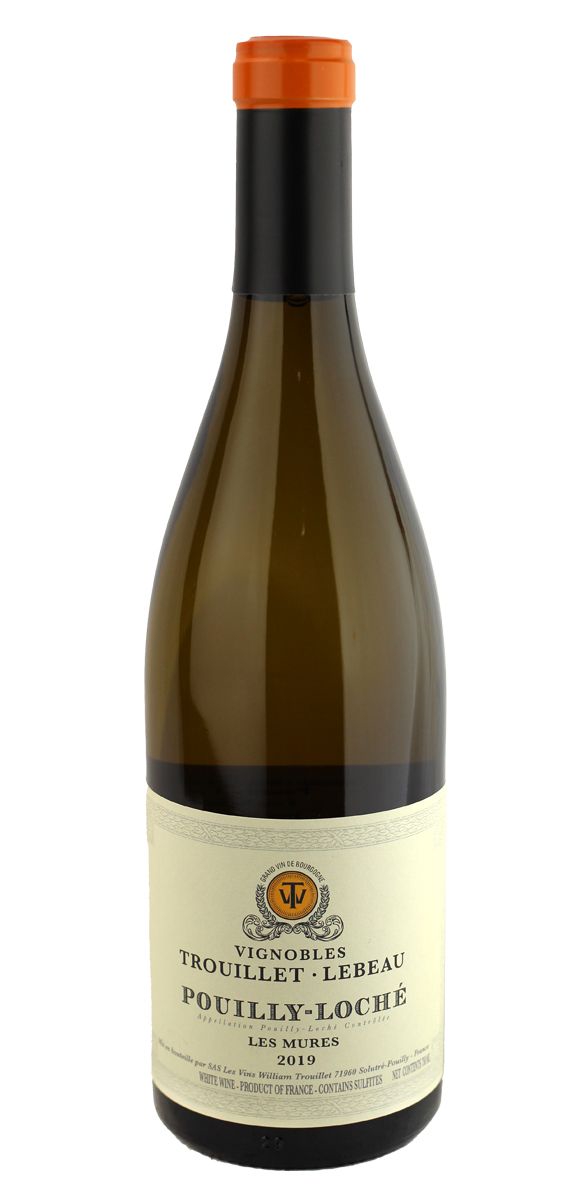
Trouillet-Lebeau Pouilly Loché Les Mures 2019
The nose shows precise yellow stone fruits with whiffs of spice and chalky minerality.  In the mouth, the fruit has breadth and weight, delivering on the promise of buoyant, perfectly ripe peach and apricot with a fine underpinning of lifting acidity and an insistent carry-through of the mineral tones, all ending with a hint of fine, wild herbs jumping on board at the finish.  A very tasty bottle of Chardonnay with surprising palate presence.  Because this isn’t a titled vineyard, it costs even less than the Chailloux and is easily one of the best Chardonnays we have has for under $25 in a long time. 
ONLY $25.98
COMPANY
© 2021 WINE EXCHANGE
CONTACT INFO
1544 East Warner Avenue, Santa Ana, CA 92705, USA
PHONE: 1-800-769-4639
FAX: 714-979-1520

{{Sender_Name}}

{{Sender_Address}}, {{Sender_City}}, {{Sender_State}} {{Sender_Zip}}

UnsubscribeUnsubscribe Preferences

The Aftermath

Obviously, we need to start this by sending wishes and prayers to all of our friends in the wake of the fires in ‘wine country’.  The loss of life is horrific and the extensive damage to property, still being assessed, is clearly catastrophic.  Our heartfelt sorrows go out in particular to those who lost their homes and businesses.


There are a lot of folks who will be offering condolences.  The media has, and will, be full of articles about people’s heroics, first responders, and other encouraging tales about the human spirit.  It does seems like there have been way too many disasters this year in particular.   There are a lot of people that will tell you they know how you feel, but most don’t.  Being helpless in the face of an overwhelming tragedy isn’t something most humans have had to experience over the last few decades.


Around here, we’ve had a bit of an inkling (more than we cared to) of what NoCal has been going through as three of the ‘characters’ in our own Winex crew were far too close for comfort to the Corona fire a couple of weeks ago and Canyon Fire 2 early this week.  Having to decide what to save, considering the immediate and long-term importance of the item, and to have to make those decisions within a very short period of time and under duress, is scary enough in itself.   Our people were fortunate to be beyond the final perimeter in those cases, but others weren’t.


It’s certainly fair to say that some of us down here didn’t realize how bad things were in Napa and Sonoma because we had our own disaster going.  It was amusing to hear the national news people talk about our fires as ‘just outside of L.A.’  We’re an hour south on a good day and substantially more in traffic.  In any case we have been ‘shaken and stirred’ here to the point where we might vaguely be able to sense the situation up there.


We actually weren’t sure what to do given the events of the past week.  We know a lot of people in the north, and have friends that did lose houses.  But we also figured that a people are a little tired of hearing about things burning.  We’re supposed to be the ‘fun’ place.  But this particular set of horrific events is right in our own back yard and, both as wine merchants and Californians, we thought we needed to say something.


The only point we would make falls in line with that whole ‘the wine business isn’t like any other’ thing.  Given the fact that there are still fires raging up there it is still too soon to assess the damage.  There have been more fatalities, more evacuations and more structures burned.  Obviously, we aren’t trying to make light of anything.  But we are starting to see articles about ‘what happens next’ and ‘rebuilding’.  That caused us to ponder a little about ‘wine’ things.


How do you rebuild?  Let’s say you are a winery.   There’s no ‘good’ timing for a fire but right now is harvest.  There are still some ‘ready’ grapes on the vine, possibly partly scorched, heat damaged, or affected by smoke.  Even if they were still ok (apparently there were cases where the expanse of green healthy vines in a vineyard acted as something of a firebreak for crops, homes and buildings), how are wineries going to get to them?  It doesn’t sound particularly healthy or safe to put a crew on picking.   So, a lot of grapes are going to be lost in the vineyard.


If you were one of the luckier ones in this earlier harvest, a lot of your grapes are harvested and fermenting.  But a lot of folks can’t get to their wineries to do some of the simple things essential to the basic making of the wine.  As we have said many times on these pages, timing is an essential part of the winemaking equation.  Not everyone does things the same way, but each winemaker has a protocol that can be pretty time intensive at this part of the process.  Failure to do certain things at the right moment can create problems that cannot be fixed later on.


There are potential risks to existing stocks from fire, smoke or heat.  Some are preventable, some are not, but someone has to be there and able to do it.  Clearly that will be a problem for a number of producers.  Even if there aren’t the ‘specifics’ we mentioned to negatively affect grapes or wine, lack of access on the part of winery crews has its own unique set of problems this time of year.


Taking it a step further, what if the winery goes altogether?  You not only have what is being made, you have a bit of what was already made and still aging in barrel.  So not only is the current ‘crop’ gone, so are portions of the last one or two vintages.  At White Rock, one of the wineries rumored to be destroyed (their website tells a more positive story), they age their Cabernet in French oak for 20 months.  So, the potential existed to lose three vintages.


The final assessment isn’t in for them.  There are storage caves on the property which may have saved a lot of the stock.  But White Rock serves as an example of what can happen.  It isn’t the first name you think of when Napa Valley is mentioned, even though they have been there for decades.  It is a unique, small production property in Soda Canyon that has a very specific style.  They have a carefully established network for sales and most folks that have been around Napa Valley for a while know who they are.


So, let’s say they did lose as many as three vintages of their red wines (hopefully not).  They could buy something else and bottle it, but it wouldn’t be the same thing that consumers have come to expect.  They could be off the market for three years and have to start the distribution process all over again, no easy feat these days.  If some of their 40-year-old vines were destroyed, it would take them, you guessed it, 40 years to get to them back to the same point.  A lot of folks went through this kind of decision-making with phylloxera in the 90s, but that was a slow, predictable process not an overnight wipeout.  You can’t plan for this sort of thing.


Finally, and again White Rock is just a real name that represents scores of wineries in every conceivable state of disarray from this terrible tragedy, what happens to such labels in the meantime?  If you make tables, and one of your tables burns, you can make another one (yeah, we know that there’s at least one guy out there mumbling no two pieces of wood are the same).  You can’t remake wine.  Vintages, vine age, blends, etc., cannot be precisely reproduced.  The competition in the marketplace is the fiercest we have seen in our decades of doing this, so coming to the market with less than your best is an uncomfortable proposition.   If you don’t come to the market at all, that’s bad for other reasons.


On top of it all, you’ve got tourism.  We are old enough to remember walking into a tasting room in the Napa Valley and seeing the owner behind the counter.  Of course, that was the 70s.  That was light years from where it is now.  It is an industry unto itself.  We read one article that said ‘wine country’ (however they defined it) had more visitors than Disneyland in the last year.  How will all of this destruction and relocation affect that aspect?


This is a nasty situation, lives lost, property lost, jobs lost, and more jobs lost by the people that support the people in the industry.  The whole industry will feel the sting of something of this magnitude in a number of different ways.   It will take weeks to assess the obvious damages, but perhaps a decade or more to see the full, as yet unpredictable impact on the region.  However, none of it matters until the winds die down and the fires subside, and that can’t come soon enough.

Into the Wood

In the course of our business we have cause to interact with a lot of winery principals and winemakers. For the most part, we are passionate about the subject and so are they. Our general rule for buying is to taste everything that comes in the door with as little comment as possible and ask questions when we have them. Invariably there will be someone on the other side of the table that pushes us to make some sort of evaluation. “What did you think?” We usually tell them honestly because we are simply too busy to sugar coat it if the answer may not be to their liking.

We don’t claim to be winemakers. But we have tasted enough wine in our lives to have a pretty good idea of what is what, and likely have been through way more variety than most of the folks that make the stuff. Sometimes the discussions can get a little heated because telling someone their wine isn’t as special as they think is like telling them their children are ugly. We get that. But we see a lot of people in a day and, frankly, if you don’t give it to them straight, they are going to take up more time trying to make a sale they are never going to make. It’s a waste of our time and theirs.

While we do know our stuff, we are respectful of the difficulty of their task. When somebody ‘nails it’, we tell them that, too, because we understand all that goes into the process. There are countless decisions to be made at every turn in winemaking, and they are all mediated by the unpredictable weather. How to farm, how to prune, when to pick, and each of a plethora of other decisions has an impact on the final stuff in the bottle.

We know some people are aware of this stuff. But it is important for everyone to step back and look at it every so often.  It helps one to really appreciate the complicated nature of the whole process and how each decision compounds to take the juice to a totally unique end result, and one that is final. If you don’t like the color of your kitchen, you can paint it. With a lot of things, you can make changes to get what you want. One supposes you can do that with wine, too, via blending. But you will never have exactly the same juice in the end because every decision makes some difference (albeit sometimes minute) and you’ll never know for sure if the wine would have been even better had you made a different decision (or several) along the way.

Just to make the point, let us simply look at the question of wood. First, of course, is deciding whether or not you want to use oak at all. For some varieties, oak barrels may not enhance the wine,  so it may not really be an option. We do know producers that, even though the varietal or genre typically does not see oak, choose to have the juice spend the time in neutral barrels simply for the transfer of oxygen and textural enhancement.

Yes we said the ‘O’ word, and oxygen is wine’s greatest enemy…except when it isn’t. Yes, that oxygen in the empty portion of a half bottle of wine will kill it. But in the cellar, the controlled introduction of oxygen via barrels of larger volumes of liquid is an important part of rounding out the finished wine. Contact with oak literally polishes the edges and softens the mid-palate, desirable in some wines but not all. It can also impart tannins which can enhance or detract depending on the wine.

So the winemaker has to first decide whether wood fits into his program at all. If it does, then the fun really begins. The winemaker has to make multiple and sometimes collective decisions about how he is going to utilize oak barrels in whatever he is making. There are several adjunct decisions that go long with that, in no particular order.

He must consider the age of the barrels. Some only want the rounding out of the wine and therefore will use only barrels that are more than three years old. At that point, the amount of flavor influence the wood itself has on the wine is virtually nil. He can decide he actually wants a fair bit of oak influence in the finished wine in which case he may choose to use all new barrels. Or he may choose to use a combination of barrels of different ages so that he has some flexibility in blending at the end.

At that point he can choose how much of the oak influence makes sense for that particular juice.
It is important to note a couple of things here. The more common regimen is to have some new barrels, some one year old and some two years old so that there are plenty of options for blending. He must also decide how long to leave it in whatever vessels he chooses as that can affect the overall profile as much as the age of the oak. There seems to be a trend away from using high percentages of new oak these days on anything except the very top cuvee, and, even at that, we hear a lot of winemakers say they are ‘dialing back’ the amount of new oak.

So you’ve decided you are going to use oak, and have an idea of what you want to try with respect to the ages of the barrels. The next step, too, presents a huge arena of choices. French or American were, and still are the usual barrel options. But these days we also hear people talking about experimenting with Hungarian, Yugoslavian, or Russian woods as well. So you decide to go French. Which forest? Each particular oak has different tightness of the grain and imparts different flavors on the finished wine. The current darlings of the elite are Taransaud and Darnajou, but you hear names like Nevers, Limosin, Troncais, Allier and Vosges fairly regularly if you are paying attention to this sort of thing.

There are different sources for American oak barrels as well, but America is a big place. Woods can come from Pennsylvania, Missouri or Oregon (and those are just a few areas we hear about), and some insist there are vast differences between those, too. Of course point some winemakers will just buy whatever is the best they can find through a broker. Other folks are very specific and get more involved. Not only is the type of wood an issue, but so is the ‘toast’ level (how much the interior wood is fire toasted). The decision to use light, medium, or heavy toast has its own distinct and significant effect on the flavors of the finished wine over and above the type of wood.

One also must decide on the cooper, the folks that make the oak barrels. There are a number of barrel producers both here and abroad, and the quality of the barrel is as important as the components. Some folks even take it a step further and have strong opinions about how the oak is ‘seasoned’. Basically, when green oak is harvested, it is not ready to be made into barrels. It needs to dry out and lose some of the moisture related flavors that would be present (and be detrimental) to a wine. The fresh wood is seasoned a number of ways, either via a drying kiln or, essentially sitting in a pile for a number of years, often outside. Three years is kind of the standard but some winemakers insist that wood is not seasoned enough until five years.

There are those that take it to the extreme of having their own barrels made to their specification. The most extreme example we heard not long ago was a winery that liked three different kinds of wood equally. So they had the cooper create barrels from alternating staves of those three different woods, with only the barrel heads toasted and not the side staves. It can get pretty specific when taken to the extreme, but usually that happens after much experimentation has been done (and a few unsatisfactory combinations sold off) and needs become more focused.

We aren’t even going to get into the financial decisions that are incumbent to any of those aspects. A top notch, new French oak barrel can cost upwards of $1500+, which ads $60 to the cost of a case of 12 bottles. If you are making even 1000 cases, the ‘oak bill’ can be substantial and one’s ability to purchase exactly what they want, when they need it, or have to cut a corner or two, is one of those decisions that nobody really wants to talk about, but it happens.

One can make comparisons between a winemaker and a chef. Sort of. There is a lot more science involved in winemaking and the financial stakes are much higher in managing an entire vintage of a wine from start to finish than creating a dish for a menu.

Our point? Well, while we don’t always agree with winemakers choices, we are respectful and mindful of the myriad of decisions they have to make on every aspect of the winemaking process. The risks are greater if you make a mistake, and there aren’t really any ‘do-overs’ as the ‘timing’ and sequence of the process is part of the equation, too. There is no rewind. So if there is that much to think about just picking out a wood program, imagine the entire process. It is demanding enough when Nature cooperates, and when it doesn’t, everything that may have worked last time may not be relevant next time.

More Random Dribblings

ALLOCATION-THE ‘A’ WORD

“I recall trying to explain the ‘allocation’ model to my late father-in-law who owned pharmacies.  Usually he couldn’t get past the part where you just couldn’t buy what you wanted.”

This was one of the most powerful words in the wine business at one time.  For some parts of the industry it still has significant meaning.  Back in the day when there weren’t thousands of wines and unlimited information, certain wines achieved a popularity that outran the supply.  For those certain labels, the solution to trying to keep as many people happy as possible was to come up with a reasonable way to apportion what there was among the various accounts/people that wanted it.  Sounds simple on the surface, and one could make the assumption that it is a somewhat fair and legitimate process with regards to its execution.  That assumption, of course, is based on an understanding of the criteria and we can tell you wineries do not likely have the same agenda in mind as you might.

I recall trying to explain the ‘allocation’ model to my late father-in-law who owned pharmacies.  Usually he couldn’t get past the part where you just couldn’t buy what you wanted.  Unless there is some crisis, the idea of ‘rationing’ (that’s what it is, really) does not come up in virtually any other business.  The object of most businesses is to sell as much as you can.  But the wine business is unlike others in that you have finite amounts of goods that cannot be reproduced or exactly replaced.  Given this unique situation, the wine industry not only sort of invented the idea of apportioning sales via ‘allocation’, but has also figured out a number of ways to use it to their advantage, as well as a few ways to muck it up and abuse it.

The original program was to first decide how much to give to restaurants and retailers, and then divvy it up between the various accounts within those categories that are deemed worthy.  Why go to so much trouble to sell what you are going to sell anyway?  The concept is to try and keep as many people involved with the label as possible so the wine/winery can maintain the largest possible audience for the future.  If production increases over time, there presumably will be a waiting clientele.  The allocation ‘lock-down’ allows the winery to micro-manage the distribution and prevents evil merchants (yes, like us) from taking down huge chunks.

It certainly helps the allocation process to have wines that people want to buy.  But not everybody likes the same things so an allocation for someone who doesn’t care about the wine seems a pointless exercise.  But it happens all the time.  There was a ‘brand manager’ for a wholesaler not long ago who somewhere along the line decided that restaurants were the key to his ‘brand building’ plan.  In this case, the importer’s book was centered on value-driven Spanish and French wines which routinely got great reviews and were enormously popular at forward-thinking retail establishments.   There was a built-in audience for these wines and the wholesaler had to do some ‘allocating’ to keep as many high performing accounts as possible as happy customers.

This ‘guru’ decided that it was important to establish these wines in restaurants even though they were selling well already on a retail level, and weren’t obvious plays in most restaurant programs.  To that end, this individual ‘allocated’ the wines to ‘restaurants only’ who proceeded to not care a lick.  Very salable wines sat at the wholesalers for months while this individual was out trying to sell them to eateries.  In one particular instance the wholesaler was sitting on 100 cases of a highly reviewed Spanish wine that was ‘allocated for restaurants’.  After four months, there were still 96 cases left to serve the Southern California market.  The wholesaler finally called ‘nonsense’, the stock was released (it sold out immediately) and the ‘brand manager’ was relieved of duty.

In most businesses people are happy to sell things.  In the wine biz, people feel the need to have input on where their wine goes.  Whether you think that is a reasonable premise or not, many times the restaurants (or whatever) on the receiving end of an allocation don’t necessarily want it.  In most cases they simply can’t use the wines.  Most restaurants don’t necessarily need another $200 Cabernet that would sit on their list at $600.  They don’t necessarily care about a high scoring Spanish wine at a French eatery.  So allocations, intended to simultaneously give an air of exclusivity to the wine and make the recipient feel special about being included in the ‘club’, are often an exercise in futility at that level.

Finally, you have the case of the winery/distributor/importer, who may have been allocating you a singular particular wine for quite some time, suddenly create/import a new wine…or, worse yet, have some leftover stock of something else.  They might include some of those ‘not-quite-so-scarce-or-in-demand’ items ‘bundled’ in your ‘allocation’, with the tacit understanding that you are expected to take your whole allocation or potentially lose the wines you really want down the road.

Yeah, we’re not huge fans of the A-word.  If we were, there’s a good chance you wouldn’t have that special bottle of wine in your cellar that you’ll be enjoying this weekend.  Make it a great one…

Random Dribblings

So, we walk into a local restaurant not long ago and see a sign at the reception desk announcing that a 3% fee will be added to the bill to compensate the cooks for the discrepancy in wages between them and the wait staff.  It goes on to explain, that while the wait staff brings you your food and receives gratuities, the cooks prepare it and, therefore, deserve a slice of the pie.  Now fair compensation is not the issue.  Every entity has to work out exactly what that means in their situation, and act accordingly.   The question is how that is supposed to come about.
One might muse that, if the cooks are indeed doing the job they are paid to do, why they would be entitled to an extra ‘spiff’ on the side.  Also, this little entitlement is automatic, whether your food was prepared well or not.  That’s like that mandatory ‘20% gratuity’ added for ‘parties larger than six’.  What is the servers’ motivation to not just ‘phone it in’ if they are going to get the same money anyway?  And all of this is in the face of an escalating minimum wage (the discussion of which would fill many pages with macro-economic arguments and be way too boring on a Sunday morning, or any time for most folks).


Is the Bay Area-styled entitlement mentality spreading south like some sort of airborne virus?  Is this kind of thinking one of the early signs that the ‘participation trophy’ generation is taking over?  What’s next, an add-on for their 401K?  Why restaurants think this is OK in the first place is the baffler, and where does it end?  A night out can rack up pretty fast already without all of the ups and extras.


Why don’t the servers divide their take with the kitchen?  The servers benefit when the food comes out on time and well prepared.  The customer is merely getting what he is paying for.  Why not just have a city tax on top of that because the city would like a little more money, too?  Then it can be like hotels where that $120 room you snagged on Expedia ends up costing you $180 after all the taxes and fees.


Long ago some angry restaurateur took out a billboard ad on the Long Beach Freeway that read, “If you can’t afford to tip, don’t eat out.”   Of course, our first response was why is it up to us to compensate your help?  The whole idea of tipping used to be tied to service where, if someone gave you a good experience, you tendered a little something extra.  Now there are bills that come with the tips at various percentages calculated for you, essentially shaming you into picking one of the options.  And if there are six or more of you, you don’t have a choice even if your service is lousy.


Nothing against the restaurant or their cooks, but this is a precedent that seems to be proliferating and there seem to be no natural boundaries.  Does any of it ensure a better experience for the consumer?  Oh yeah, them.  What happened to people simply doing the job they were paid to do to the best of their ability?  Or is that not a ‘thing’ any more?


KEEP ON TROCKEN?  PLEASE, NO


We just had our first exposure to the 2016s from Germany.  We’ve been telling you for to a while now to buy up the 2015s as it is a great vintage, one of the best in recent memory.  Not having a firm impression of the 2016s, we were pleased with the opportunity to work through 80-100 of them.  Our takeaway thus far?  Buy up the rest of the 2015s!


The wines (mostly Rieslings) showed a bit here and there, and lacked the characteristic zip that pulled many of those 2015’s together at the finish.  In other words, it looks like our participation in the vintage will be sparse at best.  There are always a few winners in every vintage.  But given what is out there from 2015, and a more few late 2015 releases coming from top sources hitting recently, 2016 looks to be a potentially minor play with, as always, a few stars, though we still have another 100+ wines to taste, including, in all fairness, many of the top Kabinett and Spätlese wines.


Frankly, we are pretty tired of every German importer telling us how important trockens (dry) are in German restaurants.  The Germans like to drink their own stuff, we get that.  But this isn’t Germany.  Here we have all kinds of cuisines, particularly Asian (Thai, Chinese, Vietnamese to name a few) that go beautifully with a crisp, classic kabinett or spätlese, the little bit of sweetness playing nicely against ginger, garlic, curries, and other spices.  No other wine pairs as well and as broadly across a multitude of dishes.


Plus, if you want to drink dry Riesling, the Austrians, Australians, and the folks in Alsace are making better examples and have been doing it longer.  And that’s just Riesling!  There are all kinds of other dry whites that will offer excellent choices…Sauvignon Blancs, Chardonnays, Grüner Veltliner, and so on.  We understand the Germans responding to trends in their own back yard.  But aside from Germans drinking German, we can’t see why the vintners are so intent on competing in an arena where they are at a distinct disadvantage outside their borders   Most trockens are sadly undernourished and lean, and far too many are simply not pleasurable.


There are those that will point to the GGs (Große Gewächse), the relatively new category of dry wines from ‘Grand Cru’ sites, as the example of elite dry German wine.  Alright, sure, some of them are pretty good but they are also rather expensive for what they deliver, many in the $50-80 range in stores and much more on wine lists.  There are certainly many more exciting choices for less money.  Yes, there are places like Baden and the Pfalz where dry wines have been the tradition for a long time.  But the Mosel’s delicate, racy demeanor does not translate well into trocken.  They are a little better in exceptional, warmer vintages, but rarely ‘great’.  The persistent question is ‘why?’


Given over 1000 years of viticulture in these places, where certain styles developed because of the terroir of the region, we have to wonder who came along and decided all of that was nonsense.  One of the great discoveries of modern winemaking is that, no matter how much technical wizardry one can employ, the most successful wines are the ones that are true to the place that they come from…essentially the same thing the monks figured out all those centuries ago.  They drink a lot of spätburgunder in Germany, too.  Doesn’t mean we’re obliged to do so.

WHAT’S UP WITH FINE DINING?

Fair question from our perspective and it is that perspective that defines our position. Granted we have pulled no punches in calling out by-the-glass failures, wine list pretense and sommeliers who have more attitude than anything else. But, as much as we have great expectations about what the fine dining experience should be, we do like to eat out and enjoy an innovative menu.

We have a lot of friends in the restaurant business, so it’s not like we’re against eating out. But we do have a little bit of an edge developed over the years working as ‘second class citizens’ in an industry that treats eateries with kid gloves and creates more advantageous programs with minimal purchase requirements for them. Why should a restaurant literally pay less, sometimes substantially less per bottle, for a two case wine order than a retailer for an order 10 to 20 times that size?  There is no business logic for that, particularly when one takes into account that restaurants are one of (if not the) highest failure rate businesses in the country. Yet it has been that way since we started.

We have had plans to address this fine dining issue for some time, but more in the context of what we see happening around us. We’re talking about the disappearance of the ‘white table cloth’ venue. Yes there are still a number of them that have opened in hotbeds like San Francisco, New York and Las Vegas. But the upscale burger palace and pizza spot have been proliferating at a much faster clip than what one would consider ‘traditional’ restaurant concepts.

Yes there are still steak houses. But how many have opened recently around you? You are much more likely to see places that serve ‘gourmet burgers’ (at $20 or so) and have an extensive selection of IPA beers, with wine service that has been given little thought beyond having both colors (red and white). The point is that places like fancy burger joints, upscale pizza places and, of course, those places dedicated to permutations of the chicken wing, are essentially a step up from the fast food the ‘next generation’ grew up on.

Is this upscale dining these days? Does Michelin have a special section for ‘gastro pubs’ and ‘wine bars’? Given the rate at which these types of venues are opening these days, they surely must be popular. But what kind of experience is the diner getting for these elevated costs? By the time you have a couple of cocktails and a couple of upscale ‘angus burgers’, the costs aren’t insignificant. Is this the millennials idea of ‘living large’? Or is this what they can afford simply because true ‘fine dining’ has become prohibitively expensive?

The other day we heard an interesting term from a well known vintner who, though he put it in a nice way, suggested that they were deigning to visit retailers like us because of the ‘restaurant crisis’. Huh? There was a clear vision in this fellow’s mind of restaurants being ‘costed’ out of existence. Rents for certain places have become almost laughably steep, food costs have been erratic, and little employee amenities like extra ‘paid’ sick days and medical insurance mandated in places like San Francisco have made profitable operation quite a challenge.

As this gentlemen went on to say, “restaurants can’t make money on food any more” and are forced to rely more on “beverage” for their profits. Essentially that translates to restaurants demanding even heavier discounts and favorable pricing to improve their bottom line from suppliers. Also, he pointed out that a lot of restaurants are raising the ‘multiples’ on their wine lists, making, say a $20 wine that would have been $60 under the old system, now closer to $100. First of all, restaurant wine was expensive enough before, so making it more expensive hardly seems like a well thought out solution.

Second, you can’t bank ‘percentages’. You bank dollars. So raising prices could (and usually does) have the opposite effect by lowering sales and thereby potentially decreasing profits. With all due respect to Uber, the stricter alcohol laws have probably lowered ‘on-sale’ wine sales over the years anyway.

So what do we have to look forward to? Well one might presume those large, cozy restaurants are a thing of the past, unless they are underwritten by a hotel or some other entity for which the restaurant is a draw that pays off in other ways. Restaurants have been seemingly getting smaller by virtue of the costs of rent and labor. Usually the sizeable venues are going to be chains that can survive based on economies of scale. This of course comes with the corporate mentality that can tone down the innovation part of the dining experience.

An emerging scenario is the deliberately small, fixed menu establishment. Something on the order of 18-30 seats, which makes the staffing needs less, with a fixed menu so food costs are much more controlled. This seems to be the ‘new wave’, gives the chef great latitude in what to serve since they know exactly what they will need, and can provide an amazing experience. Of course these experiences seem to come at a considerable cost. Dinner for two, a couple bottles of wine (with those hefty markups), tax, tip, some sort of add-on percentage for staff health care or some such, and an Uber, can run well over $1000. That’s a lot of ‘wings’.  Also, they are charging for the meal up front.  So lord help you if you get the flu. Talk about the hidden costs of illness.

Where is this going? Well, certainly the restaurant landscape is going to continue to change. Restaurants (and menus) are trending smaller, and more of the middle tier of restaurants, mostly chains, is proliferating. For a lot of folks, that’s OK. There are lots of people that like to go to the same restaurant, sit in the same chair and order the same thing (we find fine wine buyers to be substantially more adventurous as a rule). And, yeah, there will b a good number of ethnic places, too. But we may be seeing the last of a certain ‘maverick’ breed that has influenced the food scene over the last few decades.

Where are the next icon eateries going to come from? Great chefs may have to start with food trucks because of the prohibitive costs of opening a brick and mortar venue. Maybe everyone will be cooking in business parks and serving via UberEats or Eat24, or in a food court of some sort. The problem we see is that the next generation of innovators, new versions of places like Spago, Valentino, Providence, French Laundry or Boulevard, will have a much lower chance to survive and become an icon. It has never been easy. But with the current rent scenarios, mandated entitlements, and, of course, a near-double minimum wage, the road is going to be much harder for aspiring chefs and their investors.

For our part, we like to eat out, though we do have a little bit of trouble with a meal costing as much as a house payment. We, like everybody else, will see what develops. The only thing for sure is that it will continue to change, and not necessarily for the better. As for the ‘restaurant crisis’, what our vintner friend was talking about is real for wineries. With an ever increasing number of premium wine labels, serious competition from imports, and what promises to be a lot fewer places dealing in those kinds of wines in general, a lot of ‘upscale wines’ will have trouble finding homes. Then what?.

#TRENDING

At the end of our last op-ed piece, which discussed large trends in the wine business past and present, we said, “There are a couple more things we’d like to hit, like ‘sweet’ reds and kitchen sink blends in ‘cool’ packages (aka ‘Prisoner’ envy).  In many cases they are one-in-the-same.  Those are definitely trending upward much to our chagrin…”  People will say that, if such wines are popular, what’s the problem?  That’s a complicated question.

One can always make the case that any time you have something that the public is latching on to, that’s a positive.  From that perspective, it is tough to argue.  One thing that previous ‘trend’ wines like White Zinfandel, Merlot, and fizzy Portuguese pink wines in the 60s and 70s have done was create more wine drinkers.  But the backlash suffered by each and every one of these genres after they went out of vogue was rough to say the least.

One of the great quandaries for the industry over the last decade has been how to appeal to the next generation of wine drinkers, the ‘millennials’.  In thus hunt, the current trend towards reds with residual sugar and/or ‘red blends’ seems to be striking a cord with the ‘Pepsi Generation 2.0’.

The wine we would credit with starting this whole new genre of ‘sweetish reds’, made from diverse and not necessarily complimentary grapes, is “The Prisoner”.  Dave Phinney, the ‘inventor’ of this concept, candidly admitted before an interview here one day that the whole thing started as a mistake.  He had a batch of wine grapes that got a ‘stuck fermentation’.  Let us explain briefly, and not particularly technically.  As you are aware, grape juice becomes wine as the yeasts convert the sugars to alcohol (roughly in a ratio of .55 degree of alcohol for each 1 degree of sugar).  Sometimes the yeasts die before the fermentation is finished, which results in the as-yet-unfermented sugar remaining in the wine and the wine tasting sweet.

In any case, rather than try to force fermentation by introducing more aggressive yeasts, Phinney worked with blending. There are other winemaking ways to try and solve the problem, but they don’t always work. The key point is that there is noticeable sweetness in lots with that issue.  In the old days, such wines would be bottled as ‘late harvest’, telling the customer that it was ‘dessert’ style.  That made it a niche wine that people would fit into an occasional scenario but generally avoid because it was ‘sweet’.

While the discovery may have happened accidentally, the process of dealing with it was a fresh, innovative approach to the situation in creating a whole new identity.  Blend in the residual sugar lots with other wines to get it to a particularly appealing level with the perception of dryness, give it a cool name, and put an attention getting label on it.  Oh yeah, and charge a premium price.  This was genius, though not unprecedented.  Jess Jackson built an empire by making Chardonnay with a little sweetness.  The old adage people talk ‘dry’ but drink ‘sweet’ has always been true, the ‘catch’ being you simply can’t tell them it’s sweet.  But the upscale marketing was an innovative twist.

Phinney’s success in doing it with reds was a breakthrough, quality wine and the guy got paid big money for his idea. He figured out that you don’t need a lot of sweetness to fill in the cracks and round out a wine. Good for him. He used that success to ‘double down’ on the quality, locking up top vineyards sources throughout the Napa Valley to produce The Prisoner.

But his success spawned what we like to refer to as ‘Prisoner envy’.  Another winery took the leave-a-little-sugar-in-it approach to Pinot Noir and created a hugely successful brand that also sold for millions.  But the majority of the new renditions of this concept follow the basic Prisoner model of a little bit of sweetness, a ‘cool’ or irreverent label and no varietal identity.  They exist at several price levels as well so there is more market penetration and broad acceptance.  With most of these ‘copycat’ Prisoners it’s more about the label than the juice, and the fruit-sourcing for many of these bottlings has most certainly not been at the level of Phinney’s groundbreaking efforts, though many try to charge a similar price.

This has been the most significant wine trend in at least the last decade, but curiously none of the media ever mentions the residual sugar.  Do they not taste it? Some wines hide it better than others, but it is there.  It was interesting to talk to one of the winemaking principals at a well known Napa address who was also presenting his own version of this new genre.  He said that they had been measuring residual sugars in a number of wines on the market as they were trying to define their own style and found readings in some wines as high as 10%.  To give you some idea, a wine is considered ‘sweet’ if it has more than 3%!

Given the success of Prisoner, Conundrum, and the like, everyone is trying to get into the act with some sort of sweetish red of their own.  Apparently, the world is buying the stuff and, yes, ultimately it may create some new wine drinkers among that hard-to-read next generation.  The thing is that, like with white Zinfandel, Merlot, rosé, etc., the category is now expanding too fast and not everything made is as well considered (to put it politely).  Unfortunately, the wine industry will keep it up until it implodes, as they have so often with categories like those we mentioned.

So, what is our problem if it sells? Well, nothing if we were considering an option to buy stock in one of these projects (though with a definite ‘intermediate term’ frame of mind). The RSR (‘residual suger red’) from a business standpoint might make a lot of sense, particularly given the prices that some corporate entities have thrown down to buy such brands.  Sugar sells, whether the market, or the public, care to admit it.  But we definitely don’t see it as a long-term proposition.  We’ll see.

Our other objections to the wines themselves are personal.  We like wines that are definitive stylistically and have a sense of place.  To do that, you have to pay attention to both farming and winemaking.  It isn’t easy to get all of the components right but we feel the best wine expressions fall into this camp.  First off, with these multi-varietal blends, it seems wineries are ‘stepping outside the box’, but not in a good way.  There are reasons certain varietals have evolved as being able to partner with one another.  Centuries of experience and experimentation have validated certain combinations like the varietal choices in Bordeaux and the Rhone.  They have been proven to stay complimentary as a wine ages.

When you blend grape varieties that aren’t necessarily complimentary, you run the risk of some flavors overpowering and others cancelling each other out.  Sangiovese, Cabernet, and Petite Sirah with a little residual sugar and oak staves?  Why not? Everything starts to taste simply like ‘red wine’, but wrap it in a hip package and sell the sizzle and you might make it work, though that isn’t our preference.

We like when varietal characteristics show themselves and certain blends (again like Bordeaux or the Rhone) evolve in a more linear path.  That aspect is what makes wine so fascinating.  If you just put together a bunch of ‘stuff’, that’s what it will taste like.  These blends can have size, color and punch, but not necessarily the nuances and complexity that make wine unlike any other beverage.

Take an amorphous blend, tweak it with some oak chips and leave a little sugar in it, and you have a wine-like beverage that varies little from year to year.  Sounds a little like a soft drink or juice.  Plus, when you make wines this way, you have the means to constantly tinker with the blend to get a consistent profile.  But such manipulative winemaking takes away a lot of the ‘soul’ of the wine itself.  The RSRs, which have a lot of punch and roundness on entry, are often front-loaded and simple.  But they can lack finesse, sit heavy on the palate, and do not play well with anything except ribs slathered in BBQ sauce or a cowboy ribeye.

We taste a number of these through the course of what we do, and find it hard to differentiate from one jam-ball red to another, and the sweetness and/or artificial oak notes glaze over nuance and flaws alike.  Are we saying such wines are bad?  Well, not necessarily, they are just not why we drink wine.  They can be tiring to drink, matching poorly with most dishes.  As far as aging, all bets are off because the sweet veneer interferes with the layers of flavor that aging is supposed to bring out.

Curiously, we have rarely read anything in the media that calls out the overt sweetness in some of these RSRs.  In fact, a number of them get good reviews because they stand out in a crowd by virtue of their weight and overt ‘fruitiness’.  Are we the only ones that see this? Actually, we know that isn’t the case because we have had a number of candid discussions with winemakers who are trying to make their own Prisoner-esque concepts.  We think (hope?) this escalation, too, will pass.  There’s room for a few well-done examples but overkill seems to always be the end result.  Also, we are concerned that a lot of people won’t know what ‘wine’ (by our definition) is supposed to taste like, and we’ll admit our own reluctance to get behind most of them.

If this genre creates more wine drinkers, in theory that is OK.  But we have been pretty adamant about disliking the idea of wine becoming more predictable and uniform thanks to this growing manipulative bent in winemaking. ‘Mutt-blend’ RSRs are the most blatant example of this trend.  The ‘cool label’ trend that eschews information is another adjunct issue.  One guy hits a home run and everybody wants piece, at any cost.  Marketing gone wild?  Then again maybe it’s our problem and we sound like a bunch of conspiracy theorists.


The Price is Right?

Being in business today is challenging.  We could go into a lot of detail about costs of doing business, fierce competition, and the constant exposure in a world where everyone has an opinion and posts it on Yelp without fear of recourse no matter how outlandish, incorrect or vindictive.   Are we bitter?  No, we’re doing fine in these turbulent waters. That’s just the way it is, and everyone has to deal with it.

The world is a different place than it was a few decades ago, and technology has sped up the cycles of change and empowered the everyman to speak his mind whether they know what they’re talking about or not.  Again, that’s just the way it is. Back in college (about 100 years ago) we recall being in some pretty heated discussions in business school about the coming age of consumerism.  It just seemed like the children of the 60s questioned everything, including whether or not companies could run roughshod over the public with impunity any more.

What followed were drastic changes in consumer laws, Ralph Nader, and having to sign a mountain of paperwork just to have your teeth cleaned.   It’s a better world, right? Company practices are much more consumer friendly and fair (United Airlines not withstanding) and things like the ‘cooling off period’ and liberal ‘return policies’ are all there to protect consumers against themselves.  Even so, there still seems to be an itchy trigger finger when it comes to decrying someone’s business practices.

“you should always assume stupidity and ignorance before maliciousness”

It’s as if there is some sort of mass paranoia that all businesses are out to deceive the public.  These days it only takes a couple of chat-room threads to turn something into a full blown brouhaha.  Yet in this day and age, when the consumer is allowed every opportunity to back out of a purchase, retailers are vilified for things that could have just been mistakes by employees.  We jumped to the defense of a competitor for being slammed on the news for ‘deceptive practices’ because some shelf talkers on wines were misplaced or were for a prior vintage.   If it were intentional, to what end?  Ticking off consumers is not good policy.  Likely errors or lack of diligence by employee were the cause. Our creative director Patrick has a good saying that “you should always assume stupidity and ignorance before maliciousness”. Seems like a pretty useful mantra for life in general, no?

This particular rant came about because we recently read Amazon was being chastised for misstating the ‘regular prices’ on items to make their ‘sale’ price look more attractive.  We can’t imagine why a company that visible and that clearly in a position of power would do that.  The accusation apparently stemmed from them quoting ‘regular prices’ that were not actually out there.  Apparently some conspiracy theorist found a price that was a couple of bucks lower somewhere (without noting if there were special discounts from the manufacturer, coupons, club membership allowances or any one of a thousand other tactics used to make people think they are getting a deal) from the other source.  Suddenly Amazon was a bad guy.  Really?  Frankly, in the end, all that really matters is the final price, and whether it is 38.9% off or 41.6% really isn’t the issue.

Clearly Amazon doesn’t need our help.  They surely have a phalanx of lawyers for this sort of thing, and maybe they didn’t actually, or intentionally, do anything wrong.  But there seems to always be someone willing to rattle a saber and defend the common man, and some news agency looking for a headline.  That is the world we live in.  Hey, a lot of folks offer deals in the wine business, too, and use ‘regular price’ as a barometer to demonstrate the magnitude of the discount.  No doubt there are people that are ready to pounce there, too, on some perceived misrepresentation of price.

Now we aren’t saying all wine merchants are saints.  Quite the contrary, some shoot prices for merchandise they don’t actually have and some, yes, state an inflated price to make their deal look juicier.  For our part, we make every effort to find a real price before we bring it up.  With wine, there are industry wide standards for pricing, although even those are becoming more ‘fluid’ as wineries trying to sell direct to consumers undercut their own retail prices with gimmicks like club member prices etc.    So if the ‘retail’ price per bottle is $200, but anyone can call up on the phone and ‘join’ a ‘club’ for no cost and get the same bottle for the ‘membership price’ of $175, what then is the real price?

For the record, the standard markup for the wine industry is as follows, and we aren’t going to confuse the issue by calling the result a ‘markup’, ‘mark on’ or ‘margin’.  If a wine costs $10 wholesale (before any discounts or allowances), the ‘list’ price is $15, whatever you choose to call it.  Other businesses (jewelry, clothing, luxury accessories, etc) are substantially higher.  When a retailer buys direct from the winery, on a wholesale basis, that structure is traditionally the assumption. Now once there are other parties involved (like a distributor or broker), the numbers can play out a little differently because there are more fingers in the pie and different parameters.  The ‘base’ price can change and that might cause the presumed ‘retail’ to be a little different.

Thus if a distributor took a little extra bump, say $11 wholesale, and there was no winery price guidance, then the ‘stated’ retail price would be more like $16.50.  A very common occurrence is on out of state shipments, where the f.o.b. (freight on board) price of wine from California to say Texas, or Washington to California, is slightly higher than the direct ship price within the state.  Given a higher cost, a retailer might state the ‘retail price’ based on a higher cost.  Re they inflating the price?  Not necessarily.  Imports are even dicier because of the varied shipping cost not only from the point of origin to the U.S., but to whichever coast or parts in between the wine eventually goes within the U.S.  So what’s the real price?  It’s not always that easy to determine.

We get it.  There is a lot of skepticism about how businesses operate.  There are a few bad apples, this is true.  But sometimes actually determining the ‘retail’ price isn’t that easy.  Are we defending Amazon?  Not exactly. More to the point, while we aren’t naïve, we don’t think everyone is out to get you.  People are far too inclined to point to a couple of minor mistakes over thousands of products and suggest there is institutional deception happening.  Yeah, we have a few people that do that in our business, too, but only a few.

In the end if you are getting a superior product for a better price, isn’t that the issue?  But what about those price search engines like wine-searcher?  Well even those aren’t definitive for establishing a true ‘list’ price because the range can sometimes be 40-50% between the top and the bottom of the range of a wine’s price, and that’s without even knowing if all of the prices are backed by actual physical inventory or what the provenance of the particular wine is.

We try our best to be accurate.  Usually a winery will have a posted price on their website and that’s our first choice to represent as ‘original retail’.  If we can’t find the winery pricing, or in the case of imports where there isn’t a relevant price listing, we’ll consult the reviews which usually list a suggested or ‘full markup’ retail price.  We also try to say where we got the price whenever possible if it is the context of an article.  If we are making the point that something we are selling is a ‘percent off’ of an original price, we do the research to find an appropriate price comparison that we are comfortable with.  Wines come and go, but integrity and trust are long term plays.

Finally we’d like to make the point.  Yes we have been doing marketing for a long time.  We understand how it works.  Back when we started the ‘one price’ system, offering our best price ‘bottle one’ (which was pretty novel three decades ago), it took some consumer education.  Many consumers had gotten used to the fact that, under regulated ‘fair trade’ pricing in California (which ended in 1979), they got a discount for buying twelve bottles or more.  They would point out that ‘store XYZ’ gave them a 10% discount when they bought a case.  After calculating their ‘discount’ at XYZ, our price was still lower.  What really matters in the end is what you actually pay, not the real (or imagined) percentage discount you received to get there.  Happy Weekend.

2016 Bordeaux: Tristen’s Overview

Marathon Negociant Tasting

For the past two weeks, I was in France spending four days in Burgundy (I’ll get to that part of the trip later) and the rest of the time in Bordeaux hunting for deals as well as tasting the 2016’s which is the topic of this article…

Over the years, I’ve been traveling to Bordeaux for the annual En-Primeurs tasting and have experienced some of the greatest vintages ever produced in the region. As much as many will try and deny it, Bordeaux is the undisputed King of wine with a rich history going back to Roman times. There is nowhere in the world that can produce a wine that tastes quite like it. While we here at the Exchange love wines from the many regions of the world, Bordeaux has been and continues to be at or near our top selling category over our 35+ years in business.

No matter how long I’ve been going to En-Primeur, it’s always exciting to taste the wines at this early stage of their evolution.  Over the years, the bar for Bordeaux keeps getting higher and higher as investment continues to pour into the region.  Today, Bordeaux lovers are blessed. There are so many great wines being produced at all price points that there is something special for everyone willing to look. The problem is that there is so much happening, it’s getting harder to keep a finger on the pulse and on top of who’s the new up-and-coming estate.

For Bordeaux 2016… what can I say that you haven’t heard from previous great vintages… “It’s a vintage of a lifetime”!   As much as I hate to admit, I must say it surely is one of the greatest vintages I’ve ever tasted at this stage of the game.  When it comes to having your cake and eating it too, 2016 has it all.  The wines are striking with rich, intense fruit, incredible structure, silky texture, great freshness and acidity and big but velvety tannins that are sweet and seamless and finish on an up-note.  There was no specific regional winner.  From Right Bank to Left, there were estates that made some of the best wines they have ever produced.  In fact, they’re so good and so balanced, you can drink many of them now!

The 2015s are also great and I can’t’ say at this point which one I prefer as a vintage.  That’s a good problem to have.  I can say that the wines from the Northern Medoc in 2016 are uniformly sublime which was not the case in the more erratic 2015 vintage. But for the Right Bank, Pessac Leognan and Margaux, 2015 is great!  It’s the Cabernets, both Sauvignon and Franc, that make this vintage special. That in combination with great Merlot and Petit Verdot made for some spectacular wines.

So, for now, with two outstanding vintages in the chai (not to mention the very good 2014s coming to market), the city of Bordeaux is bustling and every major chateau owner has a big grin on their face.  But what does this all mean for prices in the coming months?  We’ll see.

As a retailer, we of course are excited and will participate in this campaign.  But it’s going to be tricky.   For the moment, we can’t emphasize enough that, again, Bordeaux has a chance to win the hearts of Americans.  We have a strong U.S. Dollar versus most of the world currencies, including Great Britain, one of Bordeaux’s most important markets.  However, the old saying “sound as the Pound” has a little resonance thanks to Brexit (United Kingdom’s withdrawal from the European Union).

Given that, imagine if the chateaux raise their prices 15%.  That would translate to the Brits, given the currency, as receiving nearly a 30-40% rise in the costs over the 2015s.  So the Bordelaise have to be extremely careful.  Europe, America and Great Britain are the biggest buyers of En-Primeur (China still isn’t into buying ‘paper’).  Who knows… that may change in 2016 but nobody in Bordeaux is counting on it as far as I’ve heard …we all know what happened with the 2010 vintage.

C’mon Bordeaux! Let’s make En-Primeur fun and interesting again, both to the trade and consumers.  We say that knowing that a lot of folks in the Bordeaux trade pay attention to what we say (if not always heed it).  En-Premieur may never be what it was in the mid-2000s, but it sure wouldn’t hurt to try and give people a reason to play.  Okay, maybe that’s wishful thinking.  But the opportunity is there to potentially make Bordeaux as relevant in the marketplace as it used to be prior to 2010.  It just matters how bad the chateaux owners want it.   Time will tell…

In the coming weeks, we will dissect the vintage by appellation starting with the Satellites as they’re most likely the first to release.

So in typical Wine Exchange fashion… Let the Games Begin!

-Tristen