
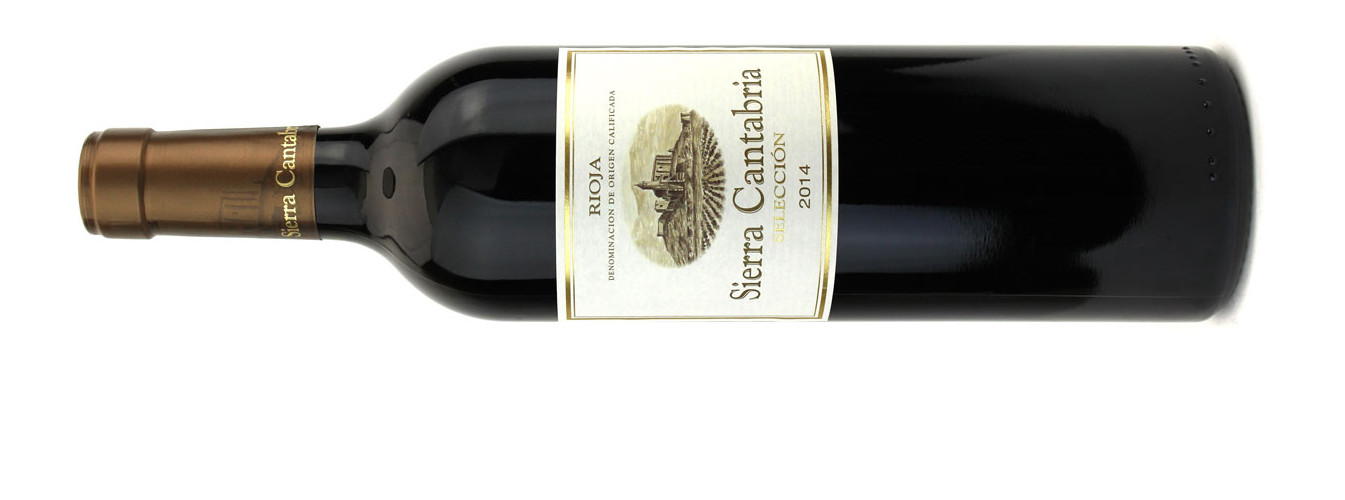
SIERRA CANTABRIA RIOJA SELECCION 2014

SIERRA CANTABRIA RIOJA SELECCION 2014

Think of this as what we used to call a wine-of-the-month, though with the new ongoing format time is a lot less linear.  An amazing deal from Spain shouldn’t surprise us. We have been on our soapbox regarding the value of Spanish wines at a wide range of price points for, what, a couple of decades now? But this one certainly did! When the purveyor pulled the bottle out of the bag, the only thing we saw was Sierra Cantabria, one of the most trusted, go-to names for us in Rioja since we began selling their wines in the mid-90s.

The Eguren family have been one of the superstars of the region not only for their range of Sierra Cantabria wines, but also their Senorio de San Vicente project that focuses on an arcane variety of Tempranillo (called Tempranillo Peludo because the leaves have a unique ‘fuzzy’ surface) that typically works on the level of a Classified Growth Bordeaux. These same folks, along with importer Jorge Ordonez, sidled over to Toro and created Numanthia (which they later sold to LVMH) which helped redefine the region. They turned right around and started Teso la Monja essentially with the same concept as Numanthia as premium Toro red.

The Egurens, even though the family has been in Rioja since the 1870s, they are ‘movers and shakers’ in the region in the most modern way. Where do they fall stylistically? They do it all, making traditional Crianzas, Reservas and Gran Resevas, as well as wines reaching for a more modern sheen with the like of Finca Eel Bosco, Reserva Unica, El Puntido and Seleccion Privada outside the traditional ‘rules’. They make more than twenty different wines, including a more ‘mass market’ enterprise under the Dominio de Eguren label.

Given our knowledge of this winery’s broad lineup, we had no idea what to expect of this label that we couldn’t remember seeing before. We tasted it with no particular expectations in mind since these folks worked on many levels. Plenty of dark fruit (strawberry, plum, currant), vanilla highlights from what appeared to be some time in oak, fine purity of fruit, and the classic chocolate/earthy notes that are a part of Rioja terroir. ‘Pretty good stuff’, we thought, ‘a fine tipple in the upper teens.’

As it turned out, this was only the second release of this wine, and the price was under $10! Our shock was legitimate. Sourced from proprietary vineyards located in San Vicente de la Sonsierra and Laguardia, this wine was 100% de-stemmed and saw 6 months in tank and 6 months in a combination of 1-3 year old American and French Bordelaise barrels.

For the price point, it was a revelation! We have been complaining for quite a while that ‘value-priced’ wines have been tasting more and more homogenized and ‘messed with’. Far too many have the prevalent flavor of wood stays or oak chip ‘teabags’ meant to give the wine the ‘impression’ of more expensive winemaking, or leave residual sweetness in the wine to fill in some of the ‘cracks’. The flavors often lean more towards industrial chocolate cake frosting and candied fruit.

This one tastes like wine! Good wine! We can’t think of a more exciting thing to say than that in a wine world that seems to be intent on using wine-making tricks to gussy up marginal, ordinary juice (the ‘lipstick on a pig’ analogy comes to mind). The Egurens are giving you delightful, honest Rioja for the same kind of price.

Not only is this a $10 wine we would happily drink ourselves, it caught the attention of the usually-not-particularly-generous Josh Raynolds of Vinous, who remarked, “…Dark ruby. Ripe dark berries, candied flowers and a suggestion of woodsmoke on the perfumed nose. Pliant and expansive in the mouth, offering bitter cherry, cassis and peppery spice flavors that become sweeter on the back half. Finishes on a juicy dark berry note, showing very good persistence, gentle tannins and lingering spice and floral notes…90 Points.”  A 90 from Josh on a wine in this price range is a rare occurence.

The Egurens know their business, but something tasty, honest, and inexpensive is the hardest thing to do in wine. Bravo. House red, party red, something that delivers in a way few $10 wines can (and, sadly, a whole lot of $15-20 wines as well), this is one to buy by the case…$9.98

VIDEO: THE EXTRACT INTERVIEWS WINEMAKER TROY KALLESKE


Have you checked out our Youtube channel, The Extract? It’s a weekly video series dedicated to wine geeks and cork dorks from novice to expert. We talk shop with wine producers, growers, and makers from all over to bring you candid discussions about wine philosophy, technique, and most of all…passion.

Here’s our most recent interview with Australian winemaker Troy Kalleske of Kalleske Wines. Troy’s family has been around the Barossa block growing grapes for over 160 years but somehow Troy is the first generation to actually make wine with them!

Enjoy.

Gauging Temperature: What happens when my wine gets hot?

Throughout the years we’ve always found ourselves caught up in discussions about the effects of certain things on a bottle of wine, predominantly temperature.  Now we could be like much of the industry and simply stick to the perfection rule that all wine must be kept between 52 and 65 degrees through all of its life or it will be ruined.  That not only refers to the storage in your home or office, and the temperature of the place where you acquired the bottle, but all points in between including the weather through which it is shipped from beginning to end.  In a perfect world, sure, why not?  But let’s face it, things in your life are rarely this perfect.

It gets warm, it gets cold, and people make mistakes.  We aren’t going to try and tell you that those fears are overblown.  But there are people out there that think anything short of perfection is actionable.  They think that the UPS driver should be there at a specific time to avoid any prolonged ride on the truck when the temperature is over 70 degrees, and that the driver should wear insulated gloves so as not to transfer any body heat to the wine when he touches it.  Yea…right. With all of the new virtual reality stuff that’s happening these days, maybe someone will come up with that perfect world.  But in the meantime, it isn’t realistic.

We once saw a merchant claim in a written advertisement that all of his wines came in refrigerated trucks. Hmm…  ‘Long haul’ trucks might be refrigerated.  We shipped a lot of loads from a Washington State importer with a company that also hauled fish.  Sometimes the truck smelled, um, like the sea?  But the wine arrived in great shape.  Shipping containers for expensive wines, and even not so expensive wines, were usually refrigerated. But as far as trucks that delivered from the local distributors, or couriers around town, we only saw one refrigerated truck per year…the Romanee Conti release.  The rest of the time they were at ambient temperature.  For everyone.

Our merchant ‘friend’ was being less than honest, but often consumers are over-the-top the other way, saying two hours on a truck at 80 degrees is ruinous.  It isn’t, and we say that knowing there are plenty of holier-than-thou types in the industry that will call us out because it is easier to be elitist.  It’s easy to preach perfection, a lot harder to actually do it where weather and human beings are involved.

We’ll tell a short story about an experience a few years ago.   I put a case of mixed Burgundies in the car after work and went off to do a bit of ‘research’.  Upon getting home, I went straight into the house, forgetting that case of Burgundy in the trunk.  I did not have occasion to go into the trunk for another week during a very warm July, essentially driving the case around town until one day when I had a reason to get into the trunk…and saw the case.  My reaction was, oh shucks (or…something like that).  But I figured it was a way to test the heat/wine thing real time (bear in mind I am a trained professional).

The heat was substantial but not extreme (90s but not over 100).  Over the course of the next month I had those twelve bottles.  Eleven of them were just fine and one was corked (which it would have been regardless of temperature).  We continued the experiment for years testing the occasional shipping ‘mishap’bottles as they came back.  For the most part, we found that in the difficult cases, the wine did show some deterioration after a few months, even sooner in the cases where the corks were pushed up (which of course would allow more oxygen to reside inside the bottle)*.   But most were good to go early on.

What we are getting at is that, much of the time, if there is a temperature ‘accident’, it is rarely the proverbial ‘bullet to the brain’.  It can, and again we are talking extremes, cause deterioration over time probably as often because the airspace in the bottle changed as being the direct effect of extreme heat or cold.  If it does happen, like we said, as long as you get to it sooner (let’s nominally say within a month or two), you should experience little if any perceptible depreciation.  So if it is a ‘drinking bottle’, as most bottles are these days, go ahead and drink it.  The one caveat is ‘natural wines’.  Since such wines are not typically stabilized, a change in temperature might occasionally set off an unanticipated reaction within the wine itself .

“wine is a living thing, which means it can take anything you can”

Obviously nobody goes out of their way to create these unfortunate scenarios.  We do our best to avoid them and mediate the weather with our shipment timing as best we can.  We tell people picking up wine that, when it’s hot, they should put their wine inside the cabin of the car where its air conditioned and go straight home.  Some don’t listen, go to the mall for two hours and complain to us because the bottle leaked.

If someone asks us to ship into Phoenix in August, we will simply say no.  One must be cautious to a point.  However weather being what it is, you never know for sure how it will play out.

In truth, most of the industry doesn’t worry about it that much.  But then something like 90% of the wine purchased is consumed with in a couple of weeks so it’s rarely ever an epidemic.  The point is we don’t live in a perfect world and sometimes stuff happens.  When it does, don’t panic.  Move those bottles up in the rotation, serve them at the proper temperature, and most of the time you’ll be just fine.  Occasionally unfiltered wines might throw off some extra sediment.  In those cases, stand them up a day or two, and then proceed as planned.

While we always practice, and recommend, exercising caution, wine is not as fragile as some might have you believe.  As someone told us once, yes wine is a living thing, which means it can take anything you can.  In other words, except in extreme cases, it isn’t ‘life or death’, at least in the short run.


* Extreme heat or cold will cause liquid to expand which will push the wine out of the cork or push the cork itself up in the neck. As it comes back to a more normal temperature the wine will contract to where it should be, minus any that pushed out.  In either case, there may be a larger air gap in the bottle, which will accelerate the process.  It’s basic physics. 

PEGASUS BAY PINOT NOIR WAIPARA VALLEY 2012

PEGASUS BAY PINOT NOIR WAIPARA VALLEY 2012

It seems like only yesterday (it was actually the mid-90s) that we were invited to a very low-keyed tasting that a supplier was hosting. That supplier, who pioneered Oregon wines in the late 80s, long before they really took hold in the broad market, had just come back from a trip to New Zealand. He brought with him bottles of Pinot Noir from New Zealand, something we had been exposed to before. Apparently the wine industry there was just starting to get a feel for the varietal and our geeky Oregon vendor felt compelled to drag a few bottles back (a lot easier to do in those days given current airport security) to test the water. Guess we were curious, too , since we attended this small scale event just to check them out. This was so early in the game, we weren’t even aware that there was a game.

Since we had no expectations, we went simply to do our jobs and taste because, as we have said so often, you just never know. The lineup of eight wines, which included Ata Rangi and Te Kairanga we recall, showed rather well. We were prompted to order small quantities of these, at the time, completely unfamiliar labels from a completely untrested genre. Perhaps more important, our take-away from this little show was “hey, this could turn into something”. Are we saying we were ahead of the curve. Yeah, we often are because we actually take the time to look. But that isn’t the point. Are we saying we could have predicted where Kiwi Pinot would go over the next couple of decades? Not a chance.

As it turned out, that showing proved to be no fluke. Here we are roughly two decades later, and the Kiwis are accepted players on the world stage. Not only are New Zealand Pinot Noirs taken seriously in wine circles these days, their ‘top guns’ have been consistently producing lights-out juice that should be a part of any serious collection. Our subject here is one of those ‘players’, Pegasus Bay. We aren’t going to claim this is the most consistent of the top drawer estates, but they certainly hit ‘higher highs’ when they’re ‘on’. This is one of those times.

The Pegasus Bay Pinot Noir Waipara Valley 2012 also gets a little less visibility because they because of their location. The name Marlborough is certainly more ingrained in the wine buying public’s psyche and Central Otago is the more ‘glam’ locale. Now we aren’t going to mix words. Sometimes Kiwi Pinots in general can be a little too savory for their own good. But when it gets a little warmer, as it did in 2012, the riper fruit component fills in the middle and plays nicely off the cooler notes while there are none of the green edges that can sometimes get in the way. That leaves a pretty compelling drink when all is said and done.

We’re not the only fans. The added ripeness and flesh (think Burgundy not Santa Lucia Highlands) got multiple ‘thumbs up’ from the critics, including a 92 from Wine Advocate and 93 from Wine Enthusiast. The lead cheerleader in this case, besides us putting our money where our mouths (keyboards?) are, was James Suckling. He dropped a ‘96’ score on this one with the comments, “A sense of real depth, soothing dark cherry notes, some forest floor and deeply knitted oak. The palate has noble tannins and the sort of structural complexity and completeness that is the envy of most other NZ Pinot Noir makers”

As a matter of course, Kiwi Pinots can use a good splash in a decanter before serving. Who knew back in the day that New Zealand would become a world player in Pinot Noir?  It is examples like this that drive the point home. As wines with this kind of reviews goes, and compared to most reserve level California Pinots, it’s quite the bargain, too…$34.98