
SOMETHING NEW FROM AN OLD SICILIAN FRIEND

The wines of Calabretta have been a part of our program for a long time. There are a couple of good reasons. One is because the wines are quite good and well represent their Mount Etna origins. But his program also offers a unique perspective in that he holds the wine back until he thinks they are ready to drink. Hence this Calabretta Nerello Mascalese Vigne Vecchie 2014 is the current release.

If you aren’t familiar with Etna, or Calabretto, here’s a brief history. Calabretta’s vineyards are located nearly a half mile above sea level in the black volcanic soils of Etna’s north slope, between Randazzo and Castiglione di Sicilia. There, Calabretta farms roughly seven hectares of mostly 70- to 80-year-old vines—many of them ungrafted—on stepped terraces supported by stone walls.

Since the winery’s founding in 1900, the Calabretta family has farmed and produced wines from Etna’s ancient indigenous varieties—including Nerello Mascalese and Nerello Cappuccio—in the mountain’s unique noble vineyards layered with a patchwork volcanic soils from various eruptions over the eons. Because of the distinct changes in soils across Etna’s slopes, comparisons are often made to Burgundy.

In fact, Calabretta’s most distinguishing feature is its dedication to long aging, which has stayed the same throughout the family’s history as winegrowers. The Etna Rosso ages much like Barolo and Brunello were aged decades ago, in massive (50- 70-hectoliter) neutral Slavonian oak botti for 6 to 7 years. The vineyard practices sound modern but are in fact rooted in the past. They avoid using chemical pesticides or herbicides, and they harvest by hand, starting around the second week of October. Fermentations are carried out exclusively with wild yeasts.

Here you have a unique combination of this distinctive soils of Etna presented when they are ready to consume, giving you the most complete experience with the genre. The Calabretta Nerello Mascalese Vigne Vecchie 2014 is definitely a stylistic nod to the past and Nerello, with its surprisingly elegant red fruits infused with the minerality and earth notes that are the essence of these ancient volcanic soils as well as spice and floral notes. The wine is full flavored but never heavy, and makes for a compelling accompaniment to hearty Italian fare, grilled meats, or roasted fowl. It’s also important to know that while 2014 wasn’t particularly notable in the northern wine regions (though there were some fans of the Barbarescos), it was an exceptional vintage in Sicily.

SPECIAL OFFER ON A CLASSIC ‘ESTATE’ RIOJA

As you surely know if you have been seeing our offers for any length of time, we have been fans of the talented folks at CVNE.  But among their three separate, high performance wineries, Contino holds a special place for us.   Back in the early 90s, before the coming of the ‘Spanish invasion’ lead by Jorge Ordonez and Eric Solomon, there were two wineries that kind of opened our eyes to the world of Spanish wines in general.  One of them was Contino (the other was Mauro for reference sake).   We have plying the varied wares from CVNE (Compañía Vinícola del Norte del España, aka Cune) under their Contino, Vina Real and Imperial labels, ever since. 

That means there is almost always something exciting from them coming under one of those three labels, all of which are run as separate wineries.  Among them Contino has a somewhat unique position.   The Cune people refer to Contino as the ‘first chateau in Rioja’, a reference to the comparison between this property and the typical profile of a Bordeaux chateau.   The estate is formed by 62 hectares of vineyard in Rioja Alavesa, considered the best of the three regional designations in Rioja (Baja, Alta, and Alavesa).  Contino, as it exists today was founded in 1973.   The history of the property itself dates from the 16th century, and that history is reflected in its name. The “contino” was the officer in charge of the guard corps of a hundred soldiers who protected the royal family “de contino” (continuously) from the times of the Catholic Monarchs onwards.

A single vineyard wine is still a pretty rare thing in Rioja, though that is changing somewhat with a surge of winemakers passionate about establishing more specific ‘village’ and ‘pago’ (vineyard) identities.  We have done a number of offers on Contino over the years, our last missive on the Rioja Gran Reserva 2012.  This time around where highlighting the Contino Reserva 2014 for a couple of reasons.  One, of course, is that it is really good again (no surprise). The other that we can offer an even better price ($10 less!) than we offered the 2009 and 2010 Reservas a while back.

This Reserva is made up of 85% Tempranillo, 10% Graciano, and 5% a combination of Mazuelo y Garnacha.  The wine is made in the traditional manner and placed in barrels already used oak (40% American and 60% French) where it  remained for two years plus the additional minimum of two more years in bottle aging in the cellars until it is released to the market.   Bright red and black fruits, spice and earth nuances, a cool feel to the flavors, it is long, well woven, and refined.   While the vintage itself is not as heralded as, say, 2001 or 2010, these folks did a fabulous job and kept it true to the style of the house.    Terroir does matter, too, and while some Riojanos got some rain in 2014, it was dry in this unique microclimate and healthy grapes were harvested without issues .

Like a Bordeaux, this wine exudes elegance. Unlike a Bordeaux chateau, this ‘current release’ already has bottle age, though it will live a couple of decades more should that be one’s wish.   The 2014 also has the usual battery of reviews including 92s from Wine Advocate, Vinous Media, and Wine Enthusiast, 90 from Wine Spectator and Decanter, 93 from Spanish publication Peñan Guide and a substantial ‘95’ from British reviewer Tim Atkins.  If everybody likes it, that is the greatest testament.  We liked it a lot ourselves for its classic elegance and lovely integration. 

As for words, Vinous Media Spanish reviewer Josh Raynolds made the point, “Deep brilliant ruby. Smoke-accented cherry, black raspberry, mocha and licorice scents are energized by suggestions of candied rose and cracked pepper. Sweet and concentrated on the palate, offering smoky, intense red and dark berry flavors that slowly become more lively with air. Smoothly blends power and energy and finishes very long and spicy, with rounded tannins and lingering florality.”

The best part is, probably because they are itching to get their hands on the highly publicized 2015 and 2016 vintages, the purveyor gave us a ‘clear the decks’ price of $29.98 (list is $51) for the Contino Rioja Reserva 2014 provided we keep it on the ‘down low’.  The price will appear at checkout.  Good hunting, quantities are limited.

‘IMMORTAL’ CABERNET

They did it to themselves.  If you call yourself ‘Immortal Cabernet,’ you had best be ready for some raised eyebrows and tough judgements.  With a name like that, you have to bring you’re ‘A game’ every time and make an impression.  Anything less than great simply will not due.  Well there is definitely intent behind every aspect of this wine because even making great wine doesn’t guarantee success. 

The story starts with a unique piece of land on the western side of the Mayacamas Mountains that is actually in Sonoma right on the border with Napa.  The depth, authority, luxurious palate and exceptional complexity of the wines from here rival anything produced on the Napa side.  The only differences are a county line and the inability of the previous owner to get peoples attention even though he made spectacular juice. 

We discovered Hidden Ridge, the former name of this spectacular vineyard planted on a 55-degree slope, some years ago. Everything seemed to be perfectly in place for these folks to become the next big thing.  The 50-acre vineyard, on a terraced hillside, was planted by respected Napa winemaker Marco Digiulio, Timothy Milos (who has a fine resume of his own and is the current winemaker), and former owner Mark Hofacket in 2004.  The sunlight, wind currents, exposure, etc. are a unique combination that seem to guarantee spectacular fruit in this plot planted to over 92% Cabernet.  We heard the story, tasted the wine (maybe an ’08?), and were suitably impressed. 

The winery’s stock should have gone up as time passed and it continued to garner huge press from Robert Parker including a couple of 97s and a vaunted ‘100’ on the Hidden Ridge Cabernet Impassable Mountain 2013.  Yet as a piece we discovered in Forbes written by a style and fashion writer, “Yet despite such critical accolades and high remarks, the vineyard and its compelling wines went largely unrecognized. The problem wasn’t the wine, but rather the branding or lack thereof.”

Sadly the original owner passed in 2016 and the property was taken over by one Tim Martin, who spent a decade with Robin Lail at Lail and founded his own targeted ‘branding’ consultancy.  The whole immortal things didn’t come about because Martin watched too many superhero or Samurai movies, but rather made reference to the immortal jellyfish.

From the same Forbes article by Stephan Rabimov, “As the only immortal being on the planet, the jellyfish is able to reset itself and transform back into an adolescent state to essentially start over. With this in mind, Martin made the mysterious creature the focal point of the vineyard’s new branding. ‘Like the immortal jellyfish on our labels, we want clients’ memories with Immortal Estate wines to live forever.”

That’s a little out there from our perspective but, hey, it’s addressing that whole ‘if a tree falls in the forest..’ thing.  Meanwhile ‘branding’ doesn’t mean much if you don’t have the goods, and the Immortal Cabernet Slope 2014 is pretty sensational juice.  Broad, deep, extracted but refined, lavishly textured, it is loaded with cassis, black cherry, baking spice, chocolate, and absolutely captivating. 

The following barrel notes from Robert Parker posted March, 2016, tell the same story:  ”As for the 2014s, the 2014 Cabernet Sauvignon Slope from the Hidden Ridge vineyard does not suffer in comparison with the extraordinary efforts of 2013. Still a barrel sample, its riveting richness, concentration, texture and density represent another legend in the making. Crème de cassis, licorice, blackberry, earthiness and spice are all present in this magnificent example of Cabernet Sauvignon that should age beautifully for 25-30+ years. When I first started doing my centralized tastings of the many wineries that I could not possibly have time to visit, one of the remarkable standouts for Cabernet Sauvignon was Hidden Ridge. These are clearly world-class Cabernet Sauvignons and should be considered by any serious collector for their cellars… 95-97+.”

For our part we are happy to get involved with this vineyard again, and definitely see that the juice has gotten even better over the years.  And, in true Winex fashion, we’ve come up with a special price at checkout to soften the perfectly justifiable $75 price, one that would be 2-3 times higher had it come from the Napa side of the line.

A ‘GIFT’ FOR YOU

Nobody brings the value drama like the Spaniards, and  that goes for every conceivable price level.  Izadi was founded in 1987 when the estate was purchased by the Anton family, who then hired Mariano Garcia (formerly Vega Sicilia, now Mauro and Aalto) as a consultant.  This bottling is from what is considered by the Anton family to be their premier site, El Regalo, a single vineyard of Tempranillo planted  in 1940 on a terroir of chalky limestone clay covered with pebbles near the village of Villabuena de Álava. 

‘El Regalo’ means ‘the gift’ in Spanish, and the family clearly considers this bottling a gift of Nature from this unique plot.  Hand harvested grapes from 70+ year old vines that are ‘practicing organically’ farmed certainly have the potential to make exciting wine. The press (94 Decanter, 91 James Suckling, 91 Wine Advocate) seems to confirm that happened here.  Firmly committed to straddling the stylistic spectrum between traditional and modern, the wine makes no reference to the typical crianza, reserve, etc. hierarchy.  It is merely “el Regalo”.  The wine sees 20 months in new French oak, more of a nod to the modern side.

The Wine Advocate shows the Izadi Rioja El Regalo 2014 at a $30 retail.  But with the current wholesale scenario of a staggering number of brands being offered through a small number of purveyors, there’s a limit to how much the ‘team on the street’ can sell in a given time period, or how committed they are to going beyond just selling the ‘easy ones’.  In such an environment, even some really good juice gets lost in the shuffle and the only way to create interest at that point is a hot price, like almost 50% off.  At $16.98, this wine becomes even more of a ‘regalo’ (gift). While it lasts.

SIERRA CANTABRIA UNICA 2014: MUY TASTY

The Eguren brothers have their fingers in a lot of pies including Dominio de Eguren in Manchuela, the single vineyard estate Senorio de San Vincente, and Teso la Monja, an estate they started after they sold their previous Toro project, Numanthia. Yeah the boys are busy (they currently operate six wineries), but it all centers around the original property founded five generations earlier in 1870, Sierra Cantabria. They started as growers that for decades sold their grapes to other wineries and they still see themselves as viticulturists first. But they clearly know what to do with the juice.

Sierra Cantabriamakes a number of different wines but this series (which started in 2008 if memory serves) has been perhaps one of the best performers all things considered. Made from vines planted in 1985 in San Vicente de la Sonsierra, the wine itself is made from 98% Tempranillo with a pinch (2%) ‘older vine Grenache’. The wine sees 24 months in 60% French and 40% American oak, 30% of which is new. There’s no pretense at ‘traditional’ styling here even though it qualifies under the law.

This is a big, ripe mouthful of plush, ripe black fruits, spice cake, earthy minerality and hints of smoke. The bottle age is clearly sufficient to take whatever edge off this wine it might have had, and it now presents itself as an open, fruit driven wave of flavor. It’s very well put together but in a more ‘bottoms up’ style that doesn’t require a lot of thinking. In other words lush, easy to like stuff. The critics seemed to like it well enough. Both Vinous’ Josh Raynolds and Wine Spectator hung 92s on this one. Raynolds said, “…Sappy and focused on the palate, offering juicy raspberry, cherry and spicecake flavors that put on weight with air. Shows excellent precision on the clinging finish, which features sweet red fruit liqueur and floral elements and harmonious, silky tannins.”

Wine Spectator’s Thomas Mathews offered, “Vanilla, sandalwood and cedar notes lend a spicy accent to the cherry, tangerine, underbrush and licorice flavors in this round red. Shows good density, with well-integrated tannins and lively acidity imparting focus. Tempranillo and Graciano. Drink now through 2026.”

The highest praise, and a bit of explanation, came from Jeb Dunnuck, “The 2014 Sierra Cantabria Reserva Única is a cellar selection of the best barrels of the Reserve, selected with the idea of making a big, rich wine that can drink well in its youth yet also age. Blackberry, blueberry, violet, peach pit, graphite, and lead pencil notes all flow to a rich, medium to full-bodied, beautifully balanced red that has good acidity, fine tannin, and a great finish. This sexy, decadent, layered beauty shouldn’t be missed! …94 points.”

It is absolutely “big, rich wine that can drink well in its youth” which will definitely make a few new friends for Spain but not at the exclusion of long time fans of Rioja.

RETURN OF THE BUNNY

This has been a wonderful recurring theme since Charlie Coniglio first walked into our office a few years ago with a Napa Cabernet in tow.  Sure we see a lot of folks peddling expensive Napa Cabernets but this one had style, depth, and the kind of vanillan, chocolatey blackcurrent theme that Cabernet drinkers love.  Even back then, $50 was considered a pretty attractive price on serious Napa Cabernet and we started to carry it in the regular lineup.  That was a 2004.  A few months later he came back to us with an extremely aggressive price on that same delicious Napa Cabernet and, well, it was an offer we couldn’t refuse.

We have done a number of deals since that time and have come to depend on this quirky relationship to keep us supplied with sensational and well priced (for the quality level) Cabernet whenever he had some to sell.  We dubbed the series ‘The Bunny’ because it is our euphemism for Coniglio, the family name (which is also the Italian word for ‘rabbit’).  ‘The Bunny’, by virtue of the series of thrilling Cabernet deals we have launched over the last half decade or so, has become something of a brand around here.

The style is remarkably consistent over the years.  We could almost cut-and-paste the descriptors from one year to the next as the style is classic, Cabernet lovers juice.   People have enjoyed these lavishly styled, full throttle Napa Cabernets, particularly at the kind of reduced prices we are selling them for.   It has been a classic win-win, and we are always interested to see what Charlie has in his bag.  The most recent ‘visit’ turned up another can’t miss Cabernet for a thirsty world.

The Coniglio Cabernet Sauvignon Napa Valley 2014 looks quietly impressive with its black label and broad-shouldered bottle.  It certainly doesn’t taste like a sub-$35 Napa Cab, though that might be because the listed winery price is $70.  Technically, this wine could have carried an even groovier Stags Leap District appellation on the label but ‘the bunny’ knows they’d probably have to charge more if they did that.  That kind of decision-making is above our pay grade and we certainly didn’t want to create a case for raising the tariff.  Let sleeping bunnies lie.

So what you have here is legit, well-endowed Stags Leap juice at a fantastic price.  This is typical ‘Bunny’ style.  You’ve got your dark, chewy, powerful Napa Cab with loads of cassis and inky black fruits, with a lovely sheen of chocolatey nuance from what tastes like expensive oak.  This wine has a bit more volume than many SLD wines, with more weight and a broader palate impression.  But the telltale elegance of the appellation lurks beneath. At $31.98 this is a pretty sensational value for a high quality Napa Cab!


KEENAN CABERNET SAUVIGNON RESERVE SPRING MTN 2014

In a ‘brave new world’ that seems overly focused on the new producer and the breakout category, it seems sometimes it’s a disadvantage to have any kind of history.  Talk about some entity that is making orange wine or early harvest Mourvedre and there seems to be a waiting cadre of folks willing to give them a look.  Talk about a proven Napa Valley label that has been around for more than three decades and you are likely to get blank stares.  But just because someone has been around a while doesn’t mean they are no longer relevant.

The history of Keenan Winery started over 40 years ago. Certain that mountain side vineyards in Napa Valley could produce world-class wines, in 1974 Robert Keenan purchased 180 acres in the Spring Mountain District at an elevation of 1700 feet. Located on the eastern slope of the Mayacamas mountain range, Spring Mountain District gained recognition as an American Vineyard Appellation (AVA) in 1993. The low vigor soils unique to the region were known to create a stressful environment for vine growth, setting up perfect conditions to encourage vineyards planted on the steep, rocky, mountainsides to produce wines of great concentration, structure, and pure varietal flavors.

The original acreage Robert acquired included the crumbling Peter Conradi Winery, founded in the late 19th Century and one of the first pioneering properties established on Spring Mountain. By the time Robert Keenan  arrived in 1974, none of the estate’s original vineyards were producing. Robert cleared the estate of tree stumps and rocks, extended the original vineyard acreage and replanted the property to Cabernet Sauvignon and Chardonnay. He built a new winery using the existing stone walls from the old Conradi building, and celebrated Keenan Winery’s first harvest there in 1977.

Robert’s son Michael took the reins in 1998 with a vision of moving the property up the quality ladder.  While those early Keenan wines were respected, many of them were ferociously tannic.  A slow deliberate process of trial and error, including the replanting of clones and the incorporation of a solar-powered system and sustainable farming (Keenan is now recognized as a ‘green’ winery) has helped the winery take the steps necessary to elevate their game and make some of the best wines in the winery’s history.

It has been interesting to watch the winery get more critical recognition as a result of this multitude of changes under the watchful, and arguably rather intense eye of Michael.  It has been clear every year when we do the tasting with him that the wines are more intense, better balanced and more refined within the context of ample, burly mountain reds.  Better grapes, better wine and every aspect is carefully watched in the process.  The result has been a Keenan lineup that is playing at a high level but has remained true to their vision of Spring Mountain as an identifiable and important terroir of the Napa Valley.

The last lineup we were presented was arguably the best yet, but the star of the show was the Robert Keenan Cabernet Sauvignon Reserve Spring Mountain 2014.  This is serious ‘mountain’ Cabernet with all of the power, depth and flavor intensity that the description implies.  Lots of dark cassis and other blue fruits highlighted with notes of chocolate and the requisite chewy, but thoroughly ripe tannins, this is impressive from front to back.

We can roll out the requisite press.  There’s a Vinous 93 with comments, “… an impeccably balanced wine that brings together firm mountain structure with ripe, unctuous fruit. Dark cherry, plum compote, spice, licorice and menthol are some of the many notes that give the Reserve its mid-palate density and sweetness. The firm tannins need time to soften, but this is impressive juice. “

There’s an even more emphatic Wine Advocate 95, offering “The (2014 Cabernet)… is the deepest, richest wine of the entire portfolio, with an opaque purple color and a super-pure nose of crème de cassis and blueberries. The wine is rich, full-bodied, nicely textured, and very long in the finish, with ripe tannins. It can be drunk now or cellared for another 15 or more years.”

High praise, to be sure.  But we can’t help but think that if the wine had a little more of a ‘trophy’ style that obliterates terroir for the sake of hedonism, with overt, lavish oak, and carried the name of one of the current media darlings, it would have garnered a couple more points and approached ‘legend’ status.  To Michael’s credit, this is as fine an expression of this vineyard, in a pure, honest style, that we have tasted from Keenan.

But we also think this effort is better even than the reviews chronicle and we’d think to ourselves that it seems to us that sometimes the ‘old guard’ has to do more to get the same recognition.  One of the Cabs of the vintage for us thus far and, given the cost of Napa reserve Cabs these day, attractively priced as well.

The Best Charbono in Years

Unless you have had a somewhat unusual wine experience, we are pretty confident that this will be the best Charbono you have had in years.  We can say that because it is very likely the only example of this varietal you are likely to have experienced over the last few years.  There is precious little even being produced any more.

Charbono has a shadowed past. To this day there is no agreed upon origin of the grape. Some suggest it comes from the northwestern part of Italy under the name Bonarda Piemontese.  Others claim it comes from the southwestern part of France and exists under the handle Corbeau or Douce Noir.  The only things that can be stated with any certainty is that the Charbono grape thrives in a harsh mountain terrain, and that it made it across the ocean as the Italians that settled California early on planted multiple-varietal field blends to assure, through diversity, there would always be some sort of crop to harvest.

For a lot of you, there is no point of reference for a wine like this.  In truth, we don’t need more than our fingers to count all of the California versions of Charbono we have had over the years.  The thing is that, among the limited experiences we have had with California versions of this varietal, there have been a disproportionate number of intriguing efforts.  So on the rare occasion we are presented with a Charbono, we pay attention.

This story is particularly interesting.  We initially were a little skeptical of the ‘program’ at Inizi, a small side project for some wine professionals who have ‘day jobs’ at other wineries.  That in itself is not a big deal.  But the fact that they were focusing on eclectic Italian varietals like Sagrantino and Tocai Friulano, and blends of things like Dolcetto and Montepulciano, gave us some concern that they were a little bit out on the fringe from a marketability standpoint.  The Inizi Charbono 2014, however, showed us some of the best traits of this somewhat hard to pinpoint grape.

The profile is engaging red and mainly black fruit, a touch of woodsiness and lots of spice, ample enough but with plenty of freshness and lift.  There’s some tobacco and vanilla in there, too. It is a delightful example of what Charbono can be. It is a unique situation.  The grapes come from the Heitz Brothers vineyard near Calistoga, a 1.5 acre plot with 40-year-old, head-trained, dry-farmed vines.

A long, dry vintage delivered great optimally ripe fruit that was 30% whole berry fermented.  About 25% saw once used barrels, the rest neutral wood, for 10 months.  Plenty to like here, Charbono is one of those grapes that has elements that remind you of other varietals, but ultimately has its own unique character.

Mauro’s Very Special V.S.

As has been obvious over the years, we are huge fans of Spanish wines.  We love the dusty plum fruit of an old Rioja and the opulence of an old vine Garnacha that tastes like a new twist on Chateauneuf.  But we also understand that these are unique flavor profiles that might take a little getting used to for someone accustomed to the straightforward, in-your-face blast of fruit from a top flight Napa Cabernet.  Well here we are going to present an immensely impressive wine that not only will pander to the hedonists who like a lot of engaging flavor up front, and purists who don’t mind modern styling provided the wine still has the trappings of classic Spanish reds, but save folks money who think you have to pay $150+ to get something truly special.

Mariano Garcia, winemaker at Vega Sicilia for about a couple of decades, is the force behind Bodegas Mauro.  This is an exceptional performer in the somewhat less defined Tierra de Castillo y Leon, sort of the outskirts of Ribera del Duero.  His ‘regular’ bottling were one of the eye opening efforts that really got us into Spanish wines back in the early 90s, and some of his reserve bottlings have been epic for their genre in the same way that certain producers have become iconic for Burgundy, Bordeaux, and Napa Valley.

This particular wine is a ‘modern’ reserve, meaning that the eye here is on making the best wine possible while no being confined to the guidelines of traditional nomenclature which carry certain rules that winemakers might find a little confining.  This wine is not made every year and comes mainly from two plots of older vineyards.  The wine was bottled in March, 2017 after spending 26 months in a combination of French and American oak.

The scents of smoke, vanilla, and chocolate harmonize beautifully with the classic cassis and plum fruit character of this 100% Tempranillo.  The entry is cool and authoritative with the intensity and dimension of the oak fused with the sleek, polished palate.  This is on par with any Classified Growth Bordeaux and we’d make the comparison with a ‘trophy’ Napa Cabernet except that the Mauro Tierra de Castillo y Leon V.S. 2014 is more harmonious and refined than most New World reds we can think of.  Packed with flavor, this plays on many levels.  You can delve into the wine’s sweet and savory complexity for an engaging intellectual exercise, or you can just sit back and let the intense, layered, toasty, chocolaty flavors roll across the palate.

This is very serious wine that, while it is true to its genre, doesn’t expect you to cross the line to appreciate the context.  There’s plenty of well-heeled but intense flavor to make quite an impression.  Yeah, 2014 was a problematic vintage in some parts of Europe.  But clearly not in the Ribera/Castillo y Leon or a wine of this magnitude would not have been possible.  This to us is that ‘crossover wine’ that will give Bordeaux and Cabernet drinkers a whole new perspective.  Killer juice here, this wine just arrived and, while this has not been reviewed, this series has averaged 95 in Wine Advocate over the last several vintages.  This is definitely one of the best versions of the V.S..

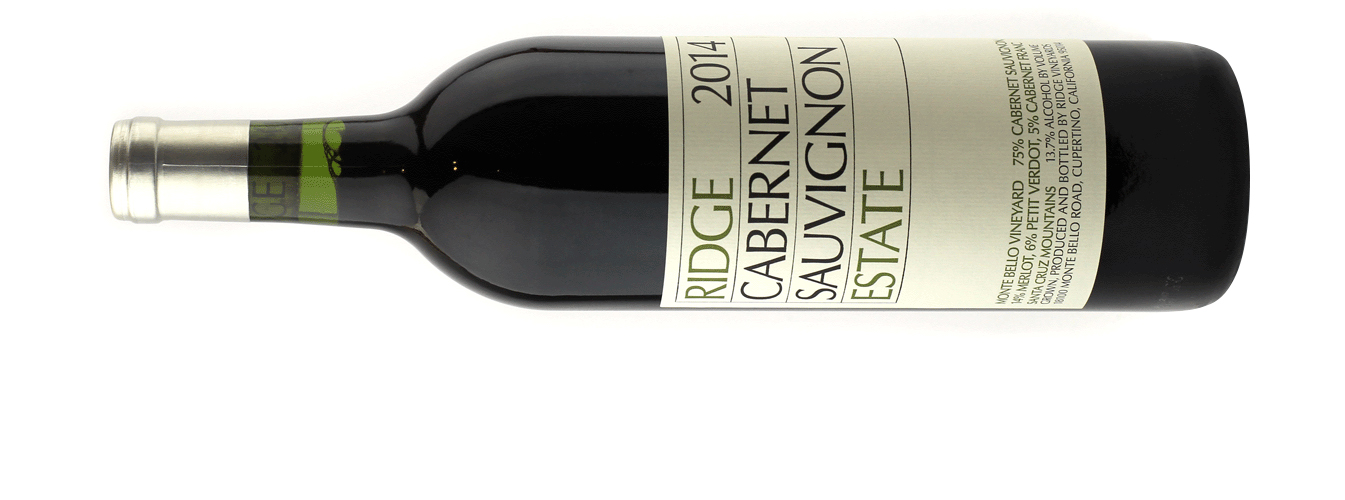
RIDGE CABERNET SAUVIGNON ESTATE 2014-Montebello Heritage, Lower Fare

One of our long time tenets has been to explore ‘other offerings’ from iconic wineries.  If you haven’t heard our reasoning it’s pretty simple.  ‘Iconic’ wines are wines that have achieved a certain status because of continued excellence over a period of time, and our thought (which has proven true time and again) is that the folks who make great wines answer to a higher standard than the rest.  A value wine for them has to still fill a certain criteria no matter what.

Over the years we have told this story a number of times, usually with the subject being something from a top Bordeaux chateau like Lafite or Pavie, a Chave or a Lodovico, or something of that ilk.  We openly admit that our usual forte is the Old World because California has eschewed the value handle it seems, almost bristling at the suggestion that anything of theirs be offered at a price that is less that whatever they divined to sell it for.  But even here, the theory can work.  It’s just a matter of finding the example.

So who is our icon?  Well, it would be difficult for any California aficionado would deny that Ridge Montebello is among the state’s most storied Cabernet series.  AS folks who have tasted these them since the late 80s, we would have the temerity to suggest that Montebello has actually gotten better over time and the current releases are among the best ever.  The problem is that the wine is becoming even more scarce and, these days, sells in the $200 range.

That’s what makes this story particularly important.  A few years back we started to see a wine called Ridge Cabernet Sauvignon Estate.  So what is it?  Well, in this case, think of Ridge Montebello’s answer to Carruades de Lafite, Les Forts de Latour, or Pavillon Rouge de Chateau Margaux.   In other words this is Ridge Cabernet from the younger vines and deselected lots of the ‘big dog’.  There was a lot of experimentation that lead to this decision, with earlier versions that were simply labeled Ridge ‘Santa Cruz Mountains’ until we started to see this nomenclature in 2008.

We liked the 2012 version of this wine quite a bit (it was also a Wine Advocate 92 and 94 Galloni), but think the new version, while perhaps a little less outgoing out of the gate than the 2012, is possibly even a touch more polished and complete.  Once again we were not alone and this Cab already has a few reviews including a 92 from former Wine Advocate scribe Jeb Dunnuck who has recently started his own service, and Antonio Galloni’s 93.

Galloni posts a rather rave review, stating “…bold, incisive flavors. Even with all of its intensity, the 2014 has a certain silkiness in its tannins that makes it approachable today. Of course, the 2014 will be even better in another few years, but opening a bottle on the early side is not a crime. The 2014 spent 27 months in French oak. Readers who are looking for a more affordable alternative to Ridge’s iconic Monte Bello should consider the 2014 Estate. Look for the Estate to be a real overachiever in 2014 as well as one of the best – possibly the best – California Cabernets in its price range.

 That’s kind of what we’re on about here.  This is a brilliant effort made up of 75% Cabernet Sauvignon, 14% Merlot, 6% Petit Verdot, and 5% Cabernet Franc, and 100% Montebello fruit! More importantly, it’s a very classy, sophisticated Cabernet essentially hidden in plain sight in the shadow of its famous sibling.  This is not a place most folks think to look for an elite Cabernet but beside performance, horse sense tells you that you can’t buy much in Napa at this level for $60-70.  So in its own way, the Ridge Cabernet Sauvignon Estate 2014, at a quarter the price of the Montebello, is a legit value for folks looking for serious Cabernet.  It’s also proof that the more affordable efforts from big time players theory works in California sometimes as well.