
SANCERRE: MORE THAN JUST WHITE WINE

A lot of you already know about things like Sancerre Rosé and Sancerre Rouge.  They have been interesting ‘alternatives’, but not necessarily something to seek out.  It seems that is changing a little bit and, while we have to allow for the fact that the vintages had an influence, we can recall too many cases where such wines could be stars in broader categories.

What are we getting at.  Well, first off, two of the best rosés we have had this year have been from… Sancerre!  That is hard to fathom in the sea of pink wine that has gushed forth this year, and we’ll admit to being just as surprised we were compelled to say it as you might be hearing it.  It all started the day we were filming a piece with Sancerre maestro Alphonse Mellot.  His 2016 traditional Sancerres were spectacular, by the way, but we expected that.  What got us scratching our heads even with all of the serious juice that was on the table was the Alphonse Mellot Sancerre Rose La Moussiere 2016.

This single-vineyard pink made from 100% Pinot Noir from a horse-plowed, limestone-rich, south-facing rolling hillside hits you up from with the classic strawberry fruit that Pinot-based rosés tend to show, but the subtle layers of insistent minerality are a bonus.  Can’t remember anything from Burgundy at this level and it’s half the price of some of those upscale Provence pinks and can play with some pretty serious dishes.

Not long after that we were presented with Andre Dezat Sancerre Rosé 2016 , an estate that, according to the small importer who now brings it in, has not had much presence in the U.S. until recently, having big clients in the U.K..  Glad this made it across the pond.  From soils that are limestone, sandy clay, and flint, this one really packs a mineral bent to the fruit.

Vinous’ Josh Raynolds’ notes ring true, “Brilliant orange-pink. Fresh strawberry, tangerine and honeysuckle on the mineral-accented nose. Bright and nervy on the palate, offering brisk red berry and orange pith flavors and a touch of white pepper. Closes stony and taut, showing good focus and a refreshing suggestion of bitter quinine.” A vivid, character-filled pink that will get your attention.

Maybe the biggest surprise of this trio is the Domaine Naudet Sancerre Rouge 2015.  Over the years we have slugged through countless undernourished Sancerre Rouges, Alsace Pinot Noirs and German Spatburgunders, many of which cost a lot more than this one.  But we dare say, here, you should not only consider this a pretty tasty, surprisingly user friendly Sancerre Rouge, but a consideration for a house Pinot!

This can hang with Pinots from anywhere and, though it is clearly more delicate than something from Santa Lucia Highlands (weight-wise think Central Otago), there is plenty of ripe cherry fruit to ‘bite into’ here.  Red berries and cherries, some earth and mineral, cool-climate tactile feel, all with the ripeness provided by the 2015 vintage.  Time will tell if this was a ‘one-off’, or some sort of break-out for the domaine.  From a 16-hectare estate founded in 1985 (with 3.5 hectare planted to Pinot…vines 20-45 years-old), this sees no wood and has modest alcohols (12.5%).   A bright, fresh, engaging Pinot.
SANCERRE’S ‘NEXT BIG THING’

Actually, the title may not be entirely ‘on point’.  In all fairness, Claude Riffault is already a big deal to fans of Sancerre.  The estate has been a consistent player producing captivating, true to type examples of the genre and getting big reviews.  What he hasn’t quite done yet is get to the upper tier price levels that it currently takes to buy labels like Vatan, Alphonse Mellot, and Paul Cotat.  However, there is little doubt that he can get there.  It wasn’t that long ago that Mellot’s wines sold for these kinds of prices (mid-$20 as opposed to around twice that now).   For now, these are still some of the best deals on elite quality Sancerre.

Riffault’s style focuses on purity, intense flavors, balance, and vineyard expression.  His last 2013s and 2015s pulled down tremendous reviews from Wine Advocate (among others) and, having tasted those two vintages ourselves, we can say without hesitation that the 2016s are right at that upper performance level.  Young Stephane Riffault has kicked up the quality here since taking the helm and has focused on more organic farming, an important point with regard to a genre like Sancerre where the wines rely on transparency.

The family owns 33 different (and quite small) plots on steep hillsides in four
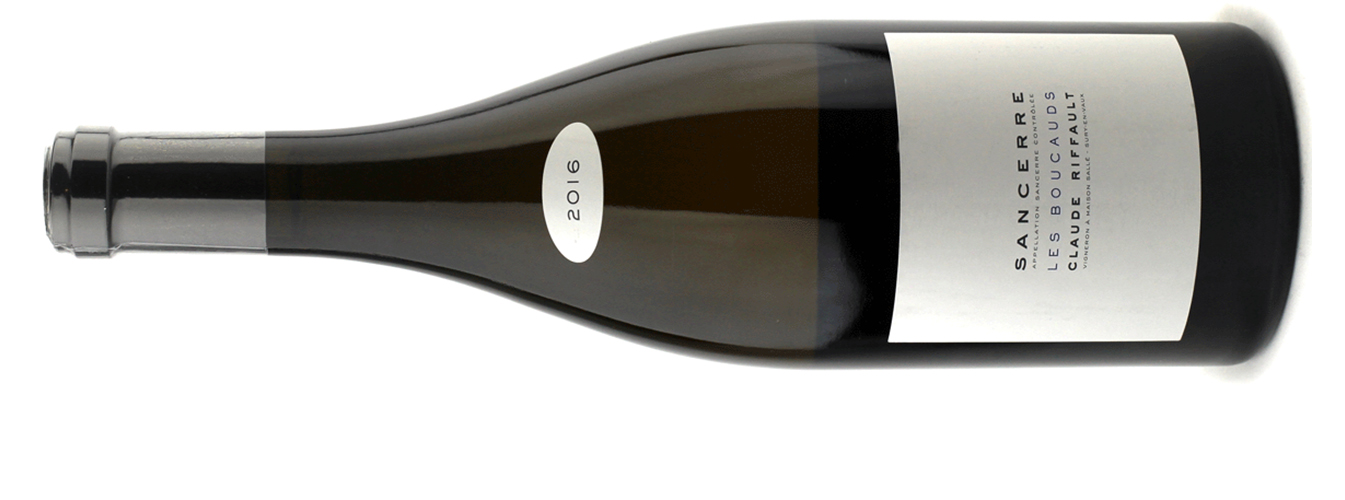
different villages. Some are limestone while others are classic flint.  Everything is hand harvested and vinified by plot.  The results speak for themselves.  The Claude Riffault Sancerre Les Boucauds 2016 comes from steep slopes of Terres Blanches soils – marls and clays over Kimmeridgian limestone. Half Steel-aged, half neutral barrels, this one is broad in the mouth with a rounded profile of ripe grapefruit, yellow stone fruits, bright flavors and a tantalizing zing of acidity to the long finish.  The Boucauds has size and power on the attack but everything is perfectly proportioned. The last one (2015) was an Advocate 92, and this one is every bit of that.

The Claude Riffault Sancerre Les Chasseignes 2016 is a subtly-but-distinctively different take on the subject.  From shallow limestone soil and subsoil containing overlapping stones, also done in half steel and half neutral oak, this one is very Sancerre but more layered and nuanced with the flavors leaning more mineral.  A little less ‘pop’, a little more complexity, sort of the white wine version of the ‘iron fist in the velvet glove’.  Last year’s effort was a glowing 93 from Advocate and this little gem is a bit better in our minds.

To us this estate is importer John David Headrick’s ‘greatest hit and this young man is putting out some serious juice.  It’s only a matter of time before these command more serious d’argent (money).  If you love Sancerre (we do!), these are a must.

Bailly-Reverdy Sancerre Chavignol 2015

We have loved the flashy Sancerres and Pouilly Fumes from the 2015 vintage, and the Bailly-Reverdy Sancerre Chavignol 2015 is a fine example of why.  The best examples have a certain density and weight on the palate with both grapefruit and kiwi fruit notes vying for attention underscored by a persistent streak of minerality and a clean, well tucked-in slice of mouth watering acidity.  The Bailly-Reverdy Sancerre Chavignol 2015 is all of that and more.  Bailly-Reverdy has been a fairly recent discovery for us but their pure, clear expression of some of Sancerre’s best dirt (in Chavignol) definitely gets us going.  A combination of different chalk-clay soils (2/3 Marly soils and 1/3 Pebbly limestone). The vines are planted on steep slopes and that makes the work to be done in the vineyards very difficult.  But the results are special.

NEAR PERFECT (98 Points) DESSERT FROM HUET

“…2015 is an exceptional and historic vintage again at Huet (perhaps the best since 1997). I can only recommend to buy cases of all styles.” – Stephen Reinhardt, Wine Advocate #227, October 2016

It doesn’t take a lot to get us to talk about one of our favorite estates in the Loire, Domaine Huet.  What with the historic aspects, including Gaston’s story as a prisoner of war in Germany, the long success of the estate upon his return, the takeover by the Hwang family, and the eventual retirement fixture Noel Pinguet (he had been there since 1971) and the eventual taking of the reins by his former assistant Jean-Bernard Berthomé, there was never a lack of material to write about.

Of course, without the wine, there is no story.  Of course, we’ll be the first to admit that the timing of the winemaking transition over the course of a couple of difficult vintages did give us cause for concern.  Was Huet, one of our favorite estates, going to become ‘just another Loire producer?’  The thought was depressing.  But Berthomé hit back-to-back home runs in 2014 and 2015 and restored our faith.

As we said in an earlier piece on the 2015s, the 2015 Huet lineup serves as an exclamation point on what will be viewed as an important harvest for the Loire.   The recent Wine Spectator article on the Loire Valley in 2015 was glowing and the ‘Top Picks’ section looked like an advertisement for Huet with the top eight wines listed, and nine of the first 11, bearing the Huet label.  At the top of the list were Huet’s dessert (moelleux) offerings, destined to become modern day legends.  We wouldn’t be at all surprised to see one pop up in the Top 100, though quantities would barely justify that (not that such things concern the press).

A great Loire sweet is in a league by itself.  The complexity of late harvest Chenin Blanc and the pristine, precise acidity will enable these wines to age decades.  Great examples like this are rare because the conditions that must exist for this ripening process to occur in the place only happen once or twice a decade.  We fondly remember the historic 1996 and 1997 vintages and recently managed to scrape up a few bottles of Huet direct from their cellars from the great 1989 vintage (we still may have a few bottles).

What we’re getting at is that, for wines like this, and Huet in particular, this is a special moment.  These are best of breed, and, while they aren’t cheap, they are bargains compared to the elite Sauternes and Beerenauslese from Germany with whom they easily can stand.  The ‘Trie’ wines in particular are super labor-intensive, the result of multiple passes (or tries) through the vineyard.

This wine, however, is a little different, as the workers go through the vineyards and pick the heavily botrytized and/or raisined grapes first, berry by berry. This is why the 1ere Trie is called 1ere Trie – it is the “first pick.”

Let us reiterate…THIS WINE IS SPECIAL.

The wines from Huet’s Le Mont vineyard, from rockier soils, have a more pronounced streak of minerality and a firmer backbone that provides the structure for aging. The Wine Advocate’s Stephan Reinhardt had the Huet Vouvray Le Mont Moelleux Première Trie 2015 pegged as his favorite, noting, “This is super clear, ripe and aromatic on the nose, highly elegant and with lovely flinty flavors. Intense and concentrated, with great finesse and vitality, this is a highly elegant and perfectly balanced wine with a persistent grip and salinity. Great balance and harmony. 98 points.”

It is the Wine Advocate’s highest-scoring Loire Valley white wine for the outstanding 2015 vintage. It literally gets no better. And at $64.98 for a full bottle, it’s certainly one of the great values in world-class dessert wine that, incidentally, could potentially find itself cozying up to some spicier Asian preparations after a decade in the cellar.

Get this world-class gem while you can, historically wines like this come long once a decade.