

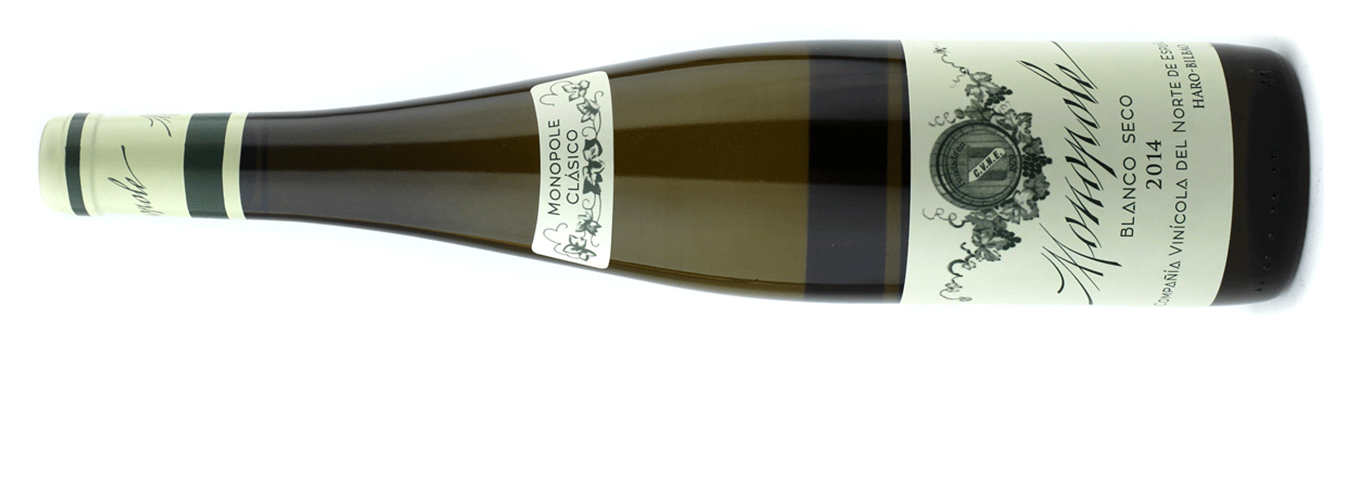
In today’s world, the search is to find something new and exciting. This would absolutely qualify on the thrilling part…but it isn’t new. As a matter of fact, it’s old. We’ll explain. A lot of you already know about the Cune Monople Blanco, something of a staple around here for the last few years and a crazy value white that has even graced the Wine Spectator Top 100. They have been making this wine this way for more than four decades. But this isn’t what we are talking about, though the 2016 is once again delicious in its own style.
What really got us excited was this new/old release called Cune Monopole Rioja Blanco Clásico 2014, the word ‘clásico’ being of particular importance. This is the reintroduction of a unique, ‘old school’ white produced prior to the 1980s. Cune’s explanation of the story is pretty clear.
“From the early 20th century to the 70s, Monopole was a staple of homes and restaurants across Spain. It was one of CVNE’s main wines. Sadly, fashion turned against it, sales fell, and production in this style ceased in the 80s. Fresh, fine, bone dry, this wine had the peculiarity and originality of having some barrel ageing with a percentage of Sherry wine, with written permission from the Rioja appellation. The Sherry added structure to the Rioja white, while they both integrated harmoniously in barrel and later in bottle.
A bottle of this old Monopole was searched for in the Haro winery’s cemetery. A solitary 1979 bottle appeared. The wine was savory, very fresh, balanced, delicious. On the spot, the decision was made: we would make this wine again, as it had been made historically. We called Ezequiel Garcia, CVNE winemaker from the 40s until the 70s, to invite him back to help us produce that wine again. Ezequiel, aka ‘the wizard’ and now in his eighties, had no doubts and said ‘Yes’ straight away.
Monopole is the story of a remake, 40 years on; this time, with the original director as guest star. And this time, handmade and in small quantities, to best ignore the whims of fashion. The wines’ aging contributes to its peculiar organoleptic characteristics, adding aromas of chamomile, dried fruits, and a long and persistent aftertaste. The marked acidity increases Monopole Clásico’s freshness.”
We loved this wine’s panache, with a nose of pear, grain, a whiff of salinity and the subtle, penetrating nuttiness of a fine, dry Sherry. Plenty of personality up front, a nice cut of acidity in the back, and lots of complexity to contemplate in between, it kind of reminded us of a Lopez de Heredia Tondonia with the wine’s natural vigor playing off the nuttiness in an aged white. The Monopole Clasico’s unique ‘recipe’ really delivers.
Wine’s Advocate’s Luis Gutierrez seemed as dazzled by this new ‘old’ gem, and reviewed it before it was even bottled…not the usual practice with Spanish whites.
“I was thinking “I wish this wine went back to the more serious bottlings of 40 and 50 years ago…” when tasting the regular Monopole, and they showed me this 2014 Monopole Clásico, which is a wine to celebrate the centenary of the brand (registered in 1914) and it blew me away. They have produced this wine like it was done in the good old times, adding some Manzanilla Sherry (yes, yes, you read it correctly); they top up the Viura with Manzanilla purchased from the Hidalgo family of Sanlúcar de Barrameda.
Not only did they add the wine (Sherry), they purchased the wine in bota, so the wine is also aged in Sherry casks. It does have an amazing nose with notes of sea breeze, iodine and esparto grass. The palate is extremely tasty, but at the same time is light and fresh, with the acidity of Viura and the kick and pungency from Manzanilla. Awesome!… This will be bottled in a couple of months, but I couldn’t help reporting on it… Welcome back, Monopole!…91-93 points.”
Awesome, indeed! Luis was obviously stoked. It is rare for him to have multiple exclamation points in an article. So are we. Even though it’s an ‘old’ style, it’s new to us, and very compelling. One of the most exciting whites we’ve had in a while, and that is saying a lot.
