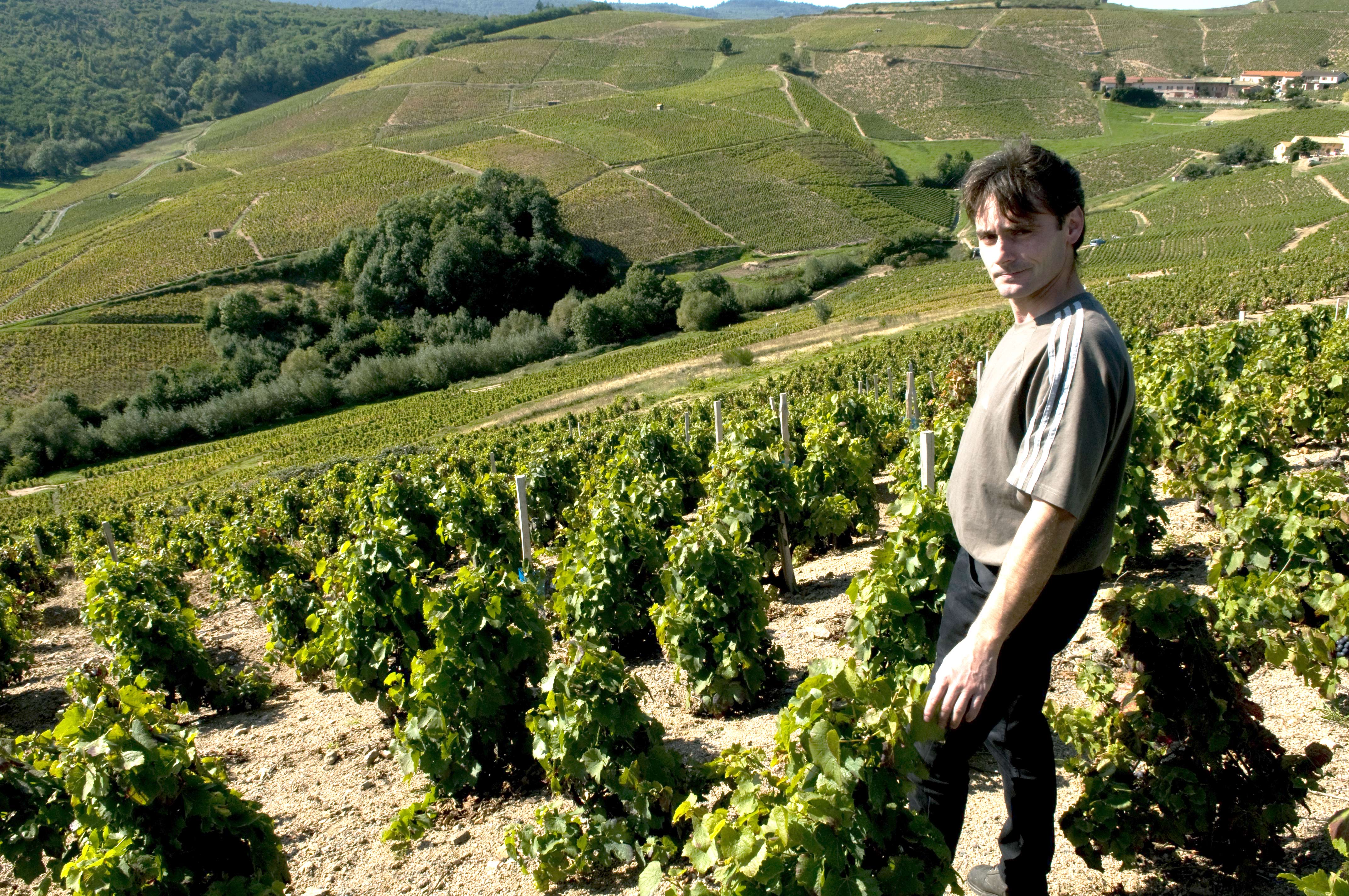
ANTHONY THEVENET MORGON LES CLOS 2021

The name is familiar. There are lots of folks named Thevenet in southern Burgundy. But they are typically white wine producers. Associating the name Thevenet with Beaujolais is, however, something fairly new for most folks. The domaine itself has only been around since 2013, and Anthony Thevenet has had to learn on the fly given the wide variations in vintages since the domaine’s inception.

Anthony is a member of Beaujolais new wave of young, passionate vignerons that hold as ideal the purity and legacy in Cru Beaujolais. In 2010, Thévenet inherited his grandfather’s vineyard in Villié-Morgon, with vines ranging from 40-150 years old. That same year he began working alongside Beaujolais icons Jean Foillard and George Descombes in the field and in the cellar. He honed his skills with these established producers and, based on this wine, he learned well. The vintage 2021 was no slam dunk but this is a gem by any standard.

All the wines are vinified with a carbonic maceration without any sulfur added until just before bottling, and they ferment at temperatures no lower than 16°C. There are no added yeasts, and the fermentations are done in a gentle, infusion style, and can last between eight to thirty days, with the latter rarer and only employed for the top wines. There is no fining or filtration, and the total sulfite levels are under 15mg/L (15ppm…extremely low). The purity and clarity of each wine’s terroir expression is due to Thevenet’s ultra-low sulfite content and his undivided attention to detail.

This is the first bottling of this cuvee, Anthony Thevenet Morgon Le Clos 2021, is from 20-year-old vines situated in granitic bedrock and sand. Even though it is done with carbonic, it has none of the cursory, simple fruitiness of a lot of commercial Beaujolais. It is, instead, more in the Burgundian, ‘old school’ style of mentor Foillard, but with a more focused style. There is weight and richness, complex aromatics, and a refined palate authority. Rather than blend it into other Morgon bottlings, Thevenet felt this cuvee made its own statement. There’s an abundance of red fruits (cherry, plum, mulberry) with subtle underpinnings of mineral as you expect from such a site, and an augmenting savory backbone. Precise and delicious, this is one of those wines that performs well above most people’s perception of its appellation.

Apparently Neal martin of Vinous, one of the few to deliver early words on the 2021s, was also in our camp,” The 2021 Morgon le Clos is the maiden release from vines just in front of the winery on soils of clay with a little sand. it undergoes a 10-day maceration. This is sprightly on the nose with rose petal infused transparent red fruit. Very elegant. The palate is medium-bodied with a life affirming mineral-driven entry. Vivid and refined with a precise tart finish that is simply one of the best you will come across in this vintage. Brilliant… 94 points.

THE STORY OF MEE: RISING BEAUJOLAIS SUPERSTAR

Since there isn’t a huge amount of wine, we aren’t going to get to far into excruciating detail. But the story of Mee Godard is one worth touching on because she has already proven to be one of the most inspiring new faces in Beaujolais and the juice in the bottle harkens memories of something from the ‘Gang of Four’s’ greatest hits.

The tale is unique for the world of wine. Mee Godard was born in Asia and adopted, growing up near Lyon in France where she studied biology and biochemistry. Somewhere during her formative years she had the opportunity and interest in tasting wines, the complexity and variation of which captured her interest.

She decided to make wine a career and studied in both Oregon and Montpellier before taking a job as a Burgundy sales rep. She knew early on that that was not her calling and her end goal was to reach as high a level of achievement in wine as possible. She felt to do that she needed to create wine from the ground up and scraped together enough to purchase some old-vine plots from a vigneron that had no heirs and was about to retire.

She has dived heart and soul into the project, with an eye to natural winemaking but the skills and the sense to keep things clean. With little more than 6 hectares in Morgon and Moulin-A-Vent her domain is fairly samll. She is meticulous in the winery. There are very few sulphites added, and her red wines are made using traditional Burgundian methods. The vinification process begins with harvesting by hand in little cases that prevent the grapes from being crushed and goes from there.

The resulting wines have depth, density, and remarkable intensity of fruit. We have had a few different selections of her wines but hadn’t pulled the trigger because her pricing was among the elite of the region. In fact, the wines deserve to be there from a price perspective and the Mee Godard Morgon Corcelette 2020 (from her original vineyard acquisition) was simply too good to pass on.

Deep, saturated color, nose showing a depth of ripe extracted fruit, and plenty of power and substance, this wine can stand with any on Beaujolais. Very impressive and, based on what we have tasted thus far, exactly what she does on a regular basis.

She got a rather lengthy note (for him) from James Suckling who wrote, “What a strikingly original wine for this region! The smoked-bacon note in the nose would have made me think of the Northern Rhone in a totally blind tasting. On the palate there’s impressive creamy richness that makes me think of bacon fat sinking into good white bread. So much drive and energy at the finish, thanks to the very healthy, dry tannins. Drink or hold…94 points.”

Mee has come a long way since her start in 2013 and we expect she is only going to gain stature as time passes. Brilliant Beaujolais in the classic old school style but without any of the funk, this is a impressive effort and a estate to watch.

AVIRON BEAUJOLAIS-BETTER LATE THAN NEVER

Given the remarkable abundance of great wines that are out in the marketplace these days, finding the right ones at the right prices is a monumental and never-ending tasking.  At the point where we actually do find something that gets us excited, particularly the ones where all of the boxes (quality, style, typicite, and price) get checked, we commit without a blink.  At that point it’s out of our hands until the wine arrives.  Often it is merely a process of the purveyor putting it on a truck and sending it.   Sometimes it becomes a lot more complicated.  This was one of those times, though we will save the particulars for another piece on the sometimes curious ways in which the industry works.

You have likely heard us jabber on about the fantastic 2015 Beaujolais.  Several months ago we had the opportunity to taste what might be some of the best values of this sensational vintage.  We started working with Stephane Aviron’s wines back with the also highly revered 2009 vintage.  At the time he was working with Nicolas Potel under the heading ‘Potel-Aviron’.  Delicious Beaujolais, fresh and fruit driven, and at remarkable prices for what they delivered, those were among the many exciting new faces we discovered with that breakout vintage in Beaujolais.

Aviron and Potel parted ways but we continued to follow Stephane because the guy could definitely make wine, and made it in the lifted, engaging, can’t-put-the-glass-down style that would win friends for the genre.  Oh yeah, and he still sold the stuff for 199os type prices.  In other words just about the best of all possible scenarios.  Needless to say when we knew we were going to have the opportunity to taste his 2015s, there was definitely interest.

The fact that the wines were compelling was no surprise.  Some of the wines that were particularly successful wasn’t necessarily what we might have predicted.  Running through the lineup, among the most impressive offerings were the Julienas and Chenas, not the appellations that usually rise above.  We picked the Stephane Aviron Chenas Vieilles Vignes 2015 between them because this appellation rarely merits this kind of attention.  Don’t get us wrong.  Good Chenas is exciting, but it is also something of a rarity as the region doesn’t necessarily have too many superstar labels (though that might be changing thanks to folks like Thillardon).

Made from pre-phylloxera vines that average over 100 years-old, from a 13.6 acre parcel that Stephan Aviron has been producing from since 1993. The soil is light and made up mostly of sand and small pebbles over a layer of clay and quartz which explains that brighter, more delicate and outgoing nature of the fruit in this engaging beverage.

While we think the Chenas is a crowd pleaser, we know the more serious Beaujolais types like to have something with a little more pedigree.  To that end, consider the Stephane Aviron Morgon Cote du Py Vieilles Vignes 2015Again the focus is on lip smacking fruit, as is the house style.  But there is more firmness, salinity, minerality, and maybe a little smoke by virtue of this respected hillside terroir.  His vineyard faces south on the slopes of this inactive volcano and the vines are a minimum of 40 years-of-age.  Like the Chenas, the well-under-$20 price is pretty enticing for a wine of this quality and this one might even benefit from some bottle age though it has that classic 2015 outgoing drinkability.

We tasted these wines way back in the early spring and they have just arrived (we have been getting deliveries of 2016s from a number of purveyors already).  Why did it take so long?  Let’s just say for some the ‘wheels of commerce’ turn more slowly.  But on the bright side, these are excellent performers at their modest fares and any opportunity to grab a few more of the flashy ’15s, especially at these kinds of prices, has to be considered a good thing.