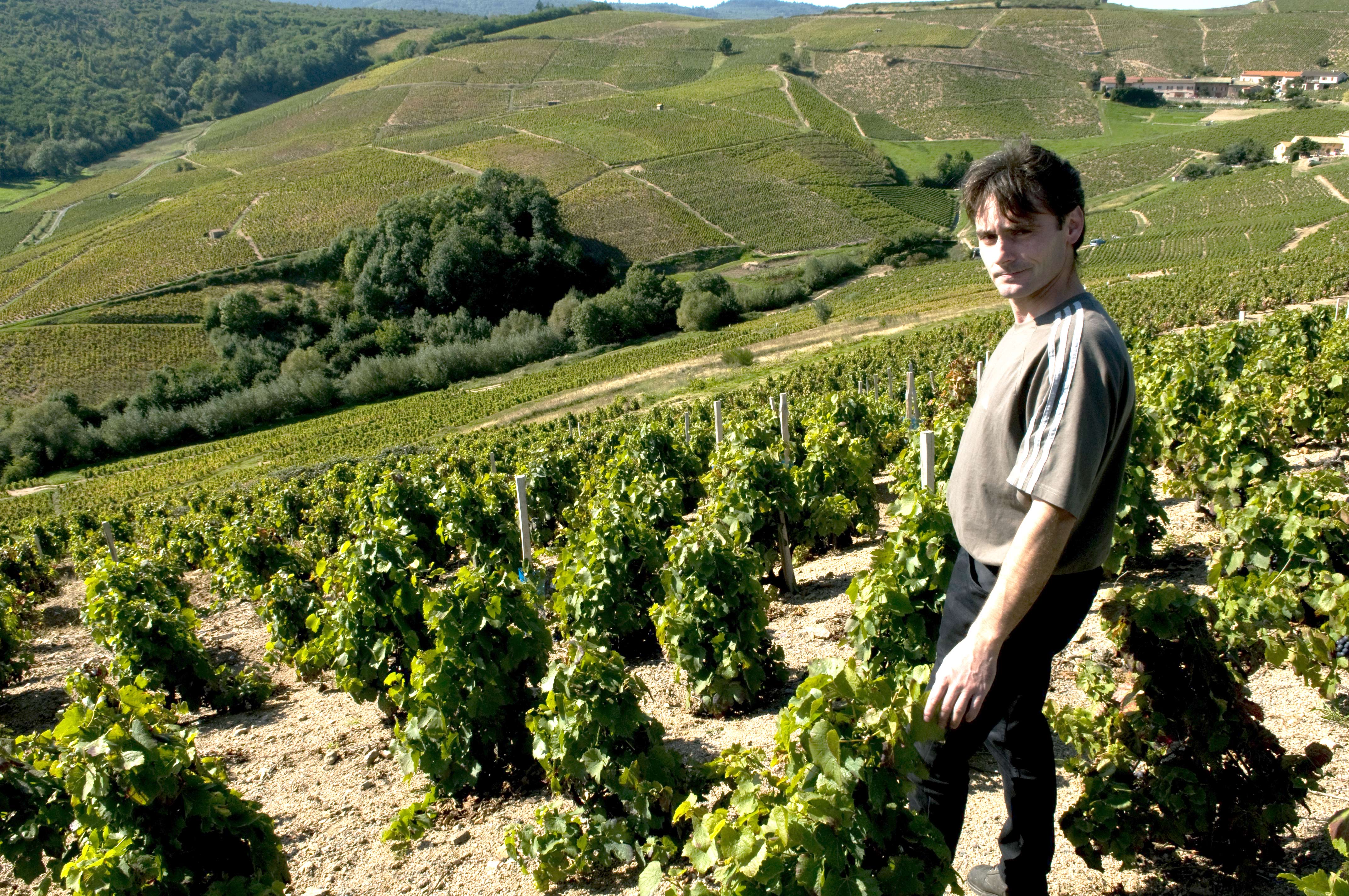
ANTHONY THEVENET MORGON LES CLOS 2021

The name is familiar. There are lots of folks named Thevenet in southern Burgundy. But they are typically white wine producers. Associating the name Thevenet with Beaujolais is, however, something fairly new for most folks. The domaine itself has only been around since 2013, and Anthony Thevenet has had to learn on the fly given the wide variations in vintages since the domaine’s inception.

Anthony is a member of Beaujolais new wave of young, passionate vignerons that hold as ideal the purity and legacy in Cru Beaujolais. In 2010, Thévenet inherited his grandfather’s vineyard in Villié-Morgon, with vines ranging from 40-150 years old. That same year he began working alongside Beaujolais icons Jean Foillard and George Descombes in the field and in the cellar. He honed his skills with these established producers and, based on this wine, he learned well. The vintage 2021 was no slam dunk but this is a gem by any standard.

All the wines are vinified with a carbonic maceration without any sulfur added until just before bottling, and they ferment at temperatures no lower than 16°C. There are no added yeasts, and the fermentations are done in a gentle, infusion style, and can last between eight to thirty days, with the latter rarer and only employed for the top wines. There is no fining or filtration, and the total sulfite levels are under 15mg/L (15ppm…extremely low). The purity and clarity of each wine’s terroir expression is due to Thevenet’s ultra-low sulfite content and his undivided attention to detail.

This is the first bottling of this cuvee, Anthony Thevenet Morgon Le Clos 2021, is from 20-year-old vines situated in granitic bedrock and sand. Even though it is done with carbonic, it has none of the cursory, simple fruitiness of a lot of commercial Beaujolais. It is, instead, more in the Burgundian, ‘old school’ style of mentor Foillard, but with a more focused style. There is weight and richness, complex aromatics, and a refined palate authority. Rather than blend it into other Morgon bottlings, Thevenet felt this cuvee made its own statement. There’s an abundance of red fruits (cherry, plum, mulberry) with subtle underpinnings of mineral as you expect from such a site, and an augmenting savory backbone. Precise and delicious, this is one of those wines that performs well above most people’s perception of its appellation.

Apparently Neal martin of Vinous, one of the few to deliver early words on the 2021s, was also in our camp,” The 2021 Morgon le Clos is the maiden release from vines just in front of the winery on soils of clay with a little sand. it undergoes a 10-day maceration. This is sprightly on the nose with rose petal infused transparent red fruit. Very elegant. The palate is medium-bodied with a life affirming mineral-driven entry. Vivid and refined with a precise tart finish that is simply one of the best you will come across in this vintage. Brilliant… 94 points.

THE STORY OF MEE: RISING BEAUJOLAIS SUPERSTAR

Since there isn’t a huge amount of wine, we aren’t going to get to far into excruciating detail. But the story of Mee Godard is one worth touching on because she has already proven to be one of the most inspiring new faces in Beaujolais and the juice in the bottle harkens memories of something from the ‘Gang of Four’s’ greatest hits.

The tale is unique for the world of wine. Mee Godard was born in Asia and adopted, growing up near Lyon in France where she studied biology and biochemistry. Somewhere during her formative years she had the opportunity and interest in tasting wines, the complexity and variation of which captured her interest.

She decided to make wine a career and studied in both Oregon and Montpellier before taking a job as a Burgundy sales rep. She knew early on that that was not her calling and her end goal was to reach as high a level of achievement in wine as possible. She felt to do that she needed to create wine from the ground up and scraped together enough to purchase some old-vine plots from a vigneron that had no heirs and was about to retire.

She has dived heart and soul into the project, with an eye to natural winemaking but the skills and the sense to keep things clean. With little more than 6 hectares in Morgon and Moulin-A-Vent her domain is fairly samll. She is meticulous in the winery. There are very few sulphites added, and her red wines are made using traditional Burgundian methods. The vinification process begins with harvesting by hand in little cases that prevent the grapes from being crushed and goes from there.

The resulting wines have depth, density, and remarkable intensity of fruit. We have had a few different selections of her wines but hadn’t pulled the trigger because her pricing was among the elite of the region. In fact, the wines deserve to be there from a price perspective and the Mee Godard Morgon Corcelette 2020 (from her original vineyard acquisition) was simply too good to pass on.

Deep, saturated color, nose showing a depth of ripe extracted fruit, and plenty of power and substance, this wine can stand with any on Beaujolais. Very impressive and, based on what we have tasted thus far, exactly what she does on a regular basis.

She got a rather lengthy note (for him) from James Suckling who wrote, “What a strikingly original wine for this region! The smoked-bacon note in the nose would have made me think of the Northern Rhone in a totally blind tasting. On the palate there’s impressive creamy richness that makes me think of bacon fat sinking into good white bread. So much drive and energy at the finish, thanks to the very healthy, dry tannins. Drink or hold…94 points.”

Mee has come a long way since her start in 2013 and we expect she is only going to gain stature as time passes. Brilliant Beaujolais in the classic old school style but without any of the funk, this is a impressive effort and a estate to watch.

THERE’S A NEW KID IN TOWN: WITH RAVISHING BEAUJOLAIS

We’ve been crusaders for Beaujolais for a long time as most of you know. Thew region has been seeing quite a revival recently as some new faces are starting to appear. While we have been long acquainted with Bernard Burgaud, one of the blue chip names in Beaujolais, this Burgaud is new to us but definitely got our attention.

Alexandre Burgaud is, relatively speaking, new to the wine scene in Beaujolais, having purchased vines in 2013. A rising star, his property comprises 12 hectares which were purchased from among plots that the family had worked for generations. Alexandre has it in mind to purchase additional parcels, some of which he currently rents.

The style here is very traditional. A semi-carbonic vinification in concrete vats, using all the stems, creates wines that are fruit forward and, in this case, gushing with character. It is finished in older barrels.

This particular wine is from a section of Beaujolais called Lantignié, where Alexandre’s best parcels are located. The vines exceed 50 years-of-age and are situated in rocky, blue granite soils that bear a resemblance to those of the Cote de Py, one of Beaujolais’ most renowned vineyards.

Some suggest this particular small vineyard could receive Cru status some day, which of course goes beyond winemaking into politics. But given our limited experience with this source, we’ll suggest Alexandre can make a pretty good case.

This wine had the kind of layered, sweet, dark fruits that would win friends easily. As an example from the appealing 2019 vintage, it also carried that plush texture that brings one back for more. It was too easy to drink and, clearly, one didn’t have to be any kind of wine genius to ‘get’ this Beaujolais.

William Kelley of WIne Advocate had good things to say about the domaine, “I identified this 12-hectare domaine, founded in 2013, as one to watch in my last Beaujolais report, and this more extensive tasting confirmed Alexandre Burgaud’s talents…Fleshy and flavorful, with the substance to age but plenty of near-term appeal, these are nicely made wines which come recommended.”

Kelley’s notes on this Alexandre Burgaud Beaujolais Villages Lantignié 2019 definitely coincide with our impressions, especially the use of the term ‘bursting’, “Bursting with aromas of cherries, berries and spices, the 2019 Beaujolais-Villages Lantignié is medium to full-bodied, round and succulent, with lively acids, melting tannins and a generous core of fruit. Slightly more dynamic and lively than the rounder, more gourmand 2018, this has turned out very well…92 points.”

‘Turned out very well’ seems a bit of an understatement, but suffice it so say this is a versatile, hedonistic, and well priced ($18.98) beverage that everyone should check out. The ‘new kid’ has got chops.

A WORD ABOUT THE BIRD

We’ve published our rather expansive recommendation list for Thanksgiving on many occasions, focusing on all the choices we think best for that holiday fowl.  We’ll sum up the basics in a couple of sentences.  First, Turkey in its various preparations is pretty versatile and plays nicely with a huge variety of wines, the only exceptions in our minds being oaky whites and heavy reds.  The choice has more to do with the accompanying items, whether they are sweeter or more savory, than it does with the bird itself.  That said, we tend to be on the savory side food-wise and our personal preferences are lighter reds like Pinot Noir or Beaujolais with the traditional roast (or smoked, or fried) bird.

Also, we think that the multifaceted menu that most people serve, the passing of food and lively conversation, don’t necessarily present the best showcasing of ‘top wines in the cellar’.  All the nuances and layers of such wines, that extra little something that puts them at a higher qualitative level, could definitely get lost in the commotion.  We tend to be thrifty sorts anyway.    As you know we always have plenty to choose from.  But this time around here are a few specific, modestly priced selections in our preferred categories that will ‘get it done’ and not break the bank.

Bonaccorsi Pinot Noir Santa Rita Hills 2018 ($19.98)- This wine is composed of grapes sourced from elite sources, Fiddlestix, John Sebastiano and a small amount Duvarita.  It’s also important to stress that the winery didn’t bottle these as single vineyards in 2018.  These aren’t the ‘remnants’ of the selection process for designate bottlings…it’s all of what they got.  The wine was held in neutral Francois Freres barrels for 20 months (to marry and round out with imparting any oaky imprint) and bottled unfiltered and unfined.  The wine itself is classic Pinot for the region.  Plenty of insistent strawberry and mulberry laced fruit with all sorts of nuance (rose, orange, tea, savory spice, and violet).  The fruit is pure, ripe, and ample and, at every turn, bright and lifted.  It’s really fine Pinot that could play at your Thanksgiving table or any white table cloth occasion, yet it is friendly in a way that it makes it comfortable to just haul off and drink.

Rene LeClerc Bourgogne Rouge 2017 ($26.98)- The ample, meaty style packed with sweet fruit is still the classic recipe here by tradition and one that is no doubt made lusher , rounder, and more engaging by the recent warmer vintages. Everything in this wine is grown in within the appellation of Gevrey Chambertin, from parcels in the Billiards, the Platière and the Pressionniers. The yields are low and this wine sees no new oak, Francois’ deference to his father. But this is as engaging, pure, and honest a Burgundy as you will find.  This is a fine, juicy example of ‘authentic’ Burgundy, with the ‘kids’ now in charge, giving props to the ‘old style’, but with the kind of finesse and hygiene that elevates the entire experience.  Ripe, maybe a little ‘chewy’ but with an intriguing lush palate presence, there’s plenty of soulful, sweet dark cherry and currant character laced with notes of mineral, earth, and leather. This is the kind of Burgundy we love to drink and a special experience for this kind of fare. Anybody else would be charging a lot more.

Pavillon de Chavannes Cote de Brouilly Cuvee des Ambassades 2020 ($21.98)- This estate was acquired by the Jambon Chanrion family around the time of the American Civil War (1861).   Today Pavillon de Chavannes consists of 37 prime acres on Mont Brouilly.  They make two cuvees, and this is the top one, Cuvee des Ambassades, which comes from 12 acres of Paul’s best parcels.  The name ‘cuvee Ambassades’ (ambassadors cuvee) is rather a literal one as this Cote de Brouilly is purchased by the Quai d’Orsay for use in French embassies around the world. It is the last wine to be bottled by the estate in a given vintage and it is the most age-worthy.  The Cote de Brouilly is all about the blue granite that is laced with volcanic porphyry, or crystallized mineral deposits.  The Cote de Brouilly appellation refers only to the higher, better-ripening parcels (the rest is simply labeled Brouilly) on the upper part of the hill.  Within those parameters, Paul’s holding are the highest and the steepest in this elevated appellation.  This is a very old school Beaujolais stylistically in the best sense.  Traditional winemaking allows this concentrated wine to showcase pure, intense red-leaning-to-black fruits with hints of spice and plenty of the granite minerality for which this particular ‘rock’ is known.  There is plenty of  fruit here, but of a cooler profile, with more lift and brighter flavors.   Mouth-filling and delicious, but also showing the more serious, structured, ‘wants-to-be-Burgundy’ side of Beaujolais.    

Georges Duboeuf Fleurie Clos des Quatre Vents 2019 ($19.98)-Why would one worry about ‘Nouveau’ when you could have something this good and ready to go here.  The 2021 vintage has a tough one anyway and the cost of air freight these days adds more to the tab.  Here we have a lovely effort from a proven source in a great vintage with multiple reviews for under $20! From the Decanter Wine Awards,  “Gorgeous aromatics of plush blackberry jam, warm bramble and toasty oak, while the expressive palate is layered with generous, full bodied bramble fruit and high, toasted oak… 97 Points. “  From James Suckling, “This has a fresh, fruity nose of raspberry, red apple, peach and watermelon. Some earth and mushroom, too. It’s medium-bodied with sleek, silky tannins. Layered and delicious. Drink now…93 points.” Serve this with a little chill and watch it disappear.

Georges Glantenay Volnay 2018 ($29.98)Ease and likeability is what always comes to mind when we think of Volnay, arguably one of Burgundy’s most appealing appellations.  Admittedly, we have a particular passion for good Volnays.  Very often Volnay, with all of its bright, spicy, lilting cherry fruit and pure flavors, is a ‘first love’ as one gets into Burgundy in the first place, and that never changes.  This is like that.  The nose opens with effusive red and dark cherry fruit that leans even a little darker with air.  There are hints of savory and earth as nuances in both the nose and subtly woven into the flavors.  There’s a little hint of toast at the back end, again purely acting as an accent to that ‘Volnacious’ fruit core.  We’ll borrow a little from Burghound in closing, “…sleek, delicious and nicely vibrant flavors possess a lilting mouthfeel (with) the sneaky long and relatively pliant finish…”  It’s really well priced as Burgundies go as a bonus.

Anselmann Spatburgunder 2014 ($14.99)Jah, Spatburgunder.  German Pinot Noir isn’t always the first wine people think of.  It’s colder there and a lot of the examples we have tasted over the years have been on the tart, thin side.  Add that to the fact that the Germans are quite proud of their Pinots, and charge a lot for them, and it isn’t a proposition that we present very often.  That’s what makes this last minute discovery fun to talk about.  This is ‘typical’, but also not so typical.  It definitely has the cooler, more savory profile of a cool climate Pinot, but also the fruit and texture to present itself to a much broader audience.  The Anselmann family holdings are located in the Pfaltz where they have been in the wine business for over 400 years.  Atypically for this region, 40% of their plantings are red grapes (Dornfelder anyone?).  This Pinot is fruit-driven and is reminiscent of strawberries, raspberries and cherries with notes of violets and sage.  The fruit has Just the right weight to fill in the palate and round it out while still keeping its typicite.  Surely the bottle age had a positive effect and we also got it at about half price!  A screaming deal and great with food. Sehr gut.

ANOTHER WINNER FROM THIVIN

This respected house was one of our first experiences with the 2019s from Beaujolais and, based on this ‘early return’, it looks to be a sensational harvest for this part of the world.  Thivin is one of the iconic estates in Cotes de Brouilly and one with considerable history.  It is the oldest estate on Mount Brouilly, circa the 15th Century, and has been in the hands of the Geoffrey family since 1877.  The vines are an average of 50-years-old and this crazy steep vineyard (an average 48% slope) is farmed organically. 

As we have stressed in the past, there are front-loaded carbonic Beaujolais and there are estate producers that produce with the utmost care and work more like great Burgundy.  Thivin is a poster child of that second group.  The wines are always good, and occasionally brilliant examples.  They can also be a bit inward on release.  That is what was striking here.  We don’t recall a deeper, richer, friendlier version of this wine out of the gate.  Saturated color, ripe berry and plum on the nose and an expansive, broad, polished feel on the palate, this has fruit and character to burn.  They have been on quite a roll, averaging 93 points from Wine Advocate for the last six, very different vintages. 

Wine Advocate Burgundy guy William Kelly was on the same page, “Bottled a mere week before I tasted it, Thivin’s 2019 Côte de Brouilly unwinds in the glass with inviting aromas of plums, red berries, warm spices and peonies. Medium to full-bodied, velvety and enveloping, it’s bright and precise, with fine depth at the core and real energy, concluding with a long, gently tannic finish. A touch finer-boned and more dynamic than the gourmand, demonstrative 2018, this is showing very well…93+.” 

It is showing well, indeed, yet history tells us that this wil age and develop for a decade at least, maybe longer, if you can keep your hands off it.  At $26.98, it delivers well above its class and reaffirms our point that Beaujolais is still the source for some of the best value reds on the planet.  It’s hard to say this is their best ever because they have had an impressive string of sensational efforts.  But this Thivin Cote de Brouilly 2019 is definitely the sexiest.

HILLTOP STAR: Pavillon de Chavannes Cote de Brouilly Cuvee des Ambassades 2016

There is more than just a passing resemblance between the label on Paul Jambon’s lengthily titled Domaine du Pavillon de Chavannes Côte de Brouilly and one of our benchmark sources from the Cote de Brouilly, Domaine Thivin.  There is a whole lot of history as well as one of the more intriguing new (to us) discoveries in the world of Beaujolais.  Now none of the folks here are newcomers, nor are they another of the wave of vintners from the Cote d’Or that have taken a recent interest in these southern Burgundy vineyards.  This estate was acquired by the Jambon Chanrion family around the time of the American Civil War (1861).

The Thivin estate had already been around for quite a while, tracing its roots back to the 14th Century, and possibly the 12th.   Fast forward a little to shortly after the First World War when Pavillon de Chavannes’ history became intertwined with that of Château Thivin.  When Yvonne Chanrion married Claude Geoffray, he controlled Thivin, then a small estate, via inheritance. Yvonne brought with her one-third of her family’s highly regarded vineyards as an inheritance, and later she acquired her sister’s one-third as well.

Over the years, Yvonne and Claude added to Thivin’s holdings with other land purchases, but the couple never bore children. Yvonne outlived her husband.  Upon her death in 1987, the sisters’ original two-thirds inheritance reverted to Paul Jambon of the Jambon-Chanrion family, along with fifty percent of the land Yvonne and Claude had purchased subsequently over the course of their marriage.  Chavannes de Pavillon was now a new expanded entity.  The Art Deco wine label, created in the 1930s, was a product of Yvonne and Claude’s marriage. After Yvonne’s death and the restoration of the Chavannes’ vineyards, this label became joint property of both Thivin and Chavannes, and now it is used by both domains under their respective names.

Cool stuff, great story, but as you know we wouldn’t be telling it if there wasn’t some pretty serious wine as a part of the latest chapter.  Mont Brouilly is a unique spot, rising to a height of 1,587 feet all by its lonesome like  an old volcanic thumb sticking out of a plain.  The Romans cultivated vines on its flanks, and almost certainly vines to one degree or another have been raised on its steep sides ever since.  Paul Jambon grew up here and is now making some impressive wine in the ‘old way’.

Today Pavillon de Chavannes consists of 37 prime acres on Mont Brouilly and Paul and Betty Jambon make two cuvées from separate vineyards. The top wine is this one, Cuvee des Ambassades, which comes from 12 acres of Paul’s best parcels.  The name ‘cuvee Ambassades’ (ambassadors cuvee) is rather a literal one as this Cote de Brouilly is purchased by the Quai d’Orsay for use in French embassies around the world. It is the last wine to be bottled by the estate in a given vintage and it is the most age-worthy.

The Cote de Brouilly is all about the blue granite that is laced with volcanic porphyry, or crystallized mineral deposits.  The Cote de Brouilly appellation refers only to the higher, better-ripening parcels (the rest is simply labeled Brouilly) on the upper part of the hill.  Within those parameters, Paul’s holding are the highest and the steepest in this elevated appellation.  As we touched on earlier, this is a very old school Beaujolais stylistically in the best sense.

Traditional winemaking allows this concentrated wine to showcase pure, intense red-leaning-to-black fruits with hints of spice and plenty of the granite minerality for which this particular ‘rock’ is known.  There is plenty of gushing fruit here, almost like a 2015, but the fruit has a cooler profile, more lift to the fruit and brighter flavors.   A recent change in the cellar (circa the 2015 vintage) has been to rack this wine in stainless steel instead of old foudres which keeps the fruit all that much fresher.  The Pavillon de Chavannes Cote de Brouilly Cuvee des Ambassades 2016 is classic Beaujolais that wants to be Burgundy, and it delivers on that promise.  Mouth-filling and delicious, you can drink it now or, like most of the top wines from the ‘Cote’, it will age as well.  Yet at $19.98 it definitely won’t break the bank.  It’s an exceptional find and a lot of wine for the d’argent.


Great, well-priced, go-to Beaujolais…we got that

As a store that has been heavy into the Beaujolais game for more than a quarter century, it is interesting to note how much more interest the genre gets now than it did a couple decades ago.  The thing it that most of that attention is devoted to the ‘cru’ level wines and folks like Liger Belair and Desjourneys who are trying to shake the traditional foundations of Beaujolais.

If you are looking for the classic, juicy, versatile example of Beaujolais, there are plenty of them out there, particularly from special vintages like 2015 and 2016.  Unfortunately they are usually the entry level wine of some producer’s hierarchy and, because they are usually overshadowed by those ‘upper cuvees’, are less likely to get the kind of reviews that will inspire buyers.

Market mechanics are a big part of the equation to be sure.  But one of the producers that has been a part of our lineup by virtue of a consistent juiciness and engaging personality to their wines is Domaine de Colette.  These guys make that fruit driven, in-your face style that will make friends and influence people…in other words classic Beaujolais.  The 2016 shows pure, ripe Gamay with very specific flavors that sit atop beautifully measured tension that gives this wine an uncommon energy along with a pleasing core of fruit.

The comments from Vinous’ Josh Raynolds on the Domaine de Colette Beaujolais Villages Coteaux de Colette 2016 are very positive, “Vivid red. Spicy, mineral-accented red berry and floral scents, along with a hint of white pepper. Juicy and focused on the palate, offering tangy red currant and strawberry flavors and a touch of allspice. Unfolds slowly, picking up a subtle floral pastille quality on the gently tannic, focused finish.’   But perhaps on a more mundane level, if you are looking for a well made, fruit driven, really pleasing Beaujolais, Colette has been a good source for us for a long time and this is a particularly good example.  Great price for the performance!

Paul Aufranc: Beaujolais in its own World

This marks the third vintage we have carried from Pascal Aufranc, one of the most distinctive Beaujolais producers we have run across.  It all started with four acres of vines in the now emerging village of Chenas (the estate is now up to 10 ha.).  The old vines for this cuvee sit at the top of a granite hill called En Remont topped with sand at a little over 1000 feet elevation.

Besides the extreme vine age (yes, they were planted in 1939) and unique exposure (south and south-west on the hill-top), these particular vines have a rather different story.  They are surrounded by forest and, therefore, are removed from being influenced by any of the other farming concerns around them.  So these  old vines pretty much exist in a world of their own.  That does much to explain why the vintages we have sold are so distinct from each other.  Each year the vines develop in harmony with that year’s weather and not much else gets in the way. As such they seem really reflect the unique nuances of each vintage.

The results we have tasted from Aufranc have been spectacular for a variety of reasons, certainly not the least of which are the really old vines sitting in a place unlike any other.  Each effort has been a poster child for the best of what the particular vintage has to offer.  The 2014 was cool, elegant and pretty, the 2015 more packed with accessible, flashy fruit though in a way that panders to hedonists that might be considered atypical (however delicious) to Beaujolais purists.

The Pascal Aufranc Chenas Vignes de 1939 2016 displays the best elements of what might be called classic Beaujolais.  There is plenty of fruit, but the fruit has verve and a cooler edge.  Lovely notes of expressive dark cherry and plum act as the central theme to a purely rendered Chenas that also demonstrates smoke, mineral, fresh herbs and exotic spice.  Plenty of fruit here, but there’s a lifted, more polished, more aristocratic bent to the flavors.

There’s plenty to like here for the hedonists still, though it’s less overtly sweet and fleshy.  As for the traditionalist, we can’t imagine a more complete rendition of the genre than this although, sadly, this one’s focus and concentration has as much to do with the small vintage crop as anything.  Grab some while you can.

AVIRON BEAUJOLAIS-BETTER LATE THAN NEVER

Given the remarkable abundance of great wines that are out in the marketplace these days, finding the right ones at the right prices is a monumental and never-ending tasking.  At the point where we actually do find something that gets us excited, particularly the ones where all of the boxes (quality, style, typicite, and price) get checked, we commit without a blink.  At that point it’s out of our hands until the wine arrives.  Often it is merely a process of the purveyor putting it on a truck and sending it.   Sometimes it becomes a lot more complicated.  This was one of those times, though we will save the particulars for another piece on the sometimes curious ways in which the industry works.

You have likely heard us jabber on about the fantastic 2015 Beaujolais.  Several months ago we had the opportunity to taste what might be some of the best values of this sensational vintage.  We started working with Stephane Aviron’s wines back with the also highly revered 2009 vintage.  At the time he was working with Nicolas Potel under the heading ‘Potel-Aviron’.  Delicious Beaujolais, fresh and fruit driven, and at remarkable prices for what they delivered, those were among the many exciting new faces we discovered with that breakout vintage in Beaujolais.

Aviron and Potel parted ways but we continued to follow Stephane because the guy could definitely make wine, and made it in the lifted, engaging, can’t-put-the-glass-down style that would win friends for the genre.  Oh yeah, and he still sold the stuff for 199os type prices.  In other words just about the best of all possible scenarios.  Needless to say when we knew we were going to have the opportunity to taste his 2015s, there was definitely interest.

The fact that the wines were compelling was no surprise.  Some of the wines that were particularly successful wasn’t necessarily what we might have predicted.  Running through the lineup, among the most impressive offerings were the Julienas and Chenas, not the appellations that usually rise above.  We picked the Stephane Aviron Chenas Vieilles Vignes 2015 between them because this appellation rarely merits this kind of attention.  Don’t get us wrong.  Good Chenas is exciting, but it is also something of a rarity as the region doesn’t necessarily have too many superstar labels (though that might be changing thanks to folks like Thillardon).

Made from pre-phylloxera vines that average over 100 years-old, from a 13.6 acre parcel that Stephan Aviron has been producing from since 1993. The soil is light and made up mostly of sand and small pebbles over a layer of clay and quartz which explains that brighter, more delicate and outgoing nature of the fruit in this engaging beverage.

While we think the Chenas is a crowd pleaser, we know the more serious Beaujolais types like to have something with a little more pedigree.  To that end, consider the Stephane Aviron Morgon Cote du Py Vieilles Vignes 2015Again the focus is on lip smacking fruit, as is the house style.  But there is more firmness, salinity, minerality, and maybe a little smoke by virtue of this respected hillside terroir.  His vineyard faces south on the slopes of this inactive volcano and the vines are a minimum of 40 years-of-age.  Like the Chenas, the well-under-$20 price is pretty enticing for a wine of this quality and this one might even benefit from some bottle age though it has that classic 2015 outgoing drinkability.

We tasted these wines way back in the early spring and they have just arrived (we have been getting deliveries of 2016s from a number of purveyors already).  Why did it take so long?  Let’s just say for some the ‘wheels of commerce’ turn more slowly.  But on the bright side, these are excellent performers at their modest fares and any opportunity to grab a few more of the flashy ’15s, especially at these kinds of prices, has to be considered a good thing.


CHATEAU DES TOURS BROUILLY 2015

CHATEAU DES TOURS BROUILLY 2015

It’s probably reasonable for us to go easy on the prologue here.  After all, we (and everybody else it seems) has generated a ton of prose about just how good the 2015s in Beaujolais are, how top flight producers are reaching back to 1947 for a reasonable comparison, and how Beaujolais is still one of the most underpriced regions in the wine world.  Based on those strong ‘bullet points’ those of you that ‘get’ Beaujolais and/or appreciate a great value will take a good look at this one.

First off, we know it gets a little confusing when it comes to names.  Aren’t there a lot of different properties containing the name ‘Tours’, which is simply French for ‘towers’?  You bet, but there are a heck of a lot of towers out in the French countryside, from little one man-lookouts to the more expected turret on a large fortified castle.  This is the only Brouilly we know of with that moniker, and it is also the first time we have brought in this small and, in this case, enormously successful effort.

The vineyards themselves consisted of an average of 45-year-old vines situated in a natural amphitheatre around the Château.  The vines are planted in sandy soils resulting from the
disintegration of the granite bedrock. In other words, nutrient poor, thin, acidic soils where are still projections of the underlying rock.  While this certainly wouldn’t be a happy place for most crops, the Gamay grape thrives here and these soils help keep the yields down.

We have been buying Beaujolais like maniacs of late because they have been everything they were reported to be…full flavored, round, packed with fruit and straight up delicious.  We took a hard look at this one because we had already put together a lineup that was formidable.  But when we tasted it, it was one of the most tawdry, shamelessly pandering examples we have had this year of any kind of red. When we heard the price, we would have been ashamed of ourselves if we didn’t buy it.

Sure there are bigger examples, more structured efforts, and certainly more famous names.  But on the hedonist scale, this was a huge scorer.  The black and red fruit component showed near perfect ripeness, it was lush and still light of its feet, and the texture was absolutely charming.  You will have a hard time finding something sexier for this kind of fare.

Josh Raynolds of Vinous took a shine to it as well, writing “Bright violet. Spicy and sharply focused on the nose, displaying vibrant red berry, cherry and spicecake aromas and a hint of blood orange. Taut, juicy and energetic in style, offering zesty raspberry and bitter cherry flavors that flesh out slowly and turn sweeter with air. Closes long and juicy, featuring resonating spiciness and a late jolt of smoky minerality. ”  Simply a lovely drink, and that is the point…$15.98